If I ranked my moments as a father (don't worry, I'll spare you), our family's recent trip to Minnesota would be up there.
I haven't done much research on this, but indoor waterparks are all the rage in the Upper Midwest (maybe they're all over the country). Going to the waterpark is one activity outside of Christmas and Halloween that captures my oldest daughter's attention every time. We make a little pilgramage about twice a year to a water park, and she will look forward to it for weeks, discussing it often with her teachers, even to the point of interrupting me in the middle of a sermon on Sunday morning: "Dad, can we go to the water park now?"
We've found a place that suits our family well for price, size of park, quality of hotel accommodations, and proximity to other things we want to do. What made this trip so great was that I connected with my daughters in a rare way. One thing I have discovered as my household manager is that when I am at home, I find it difficult to concentrate, because I am always thinking about the next household project--whether it be a little task such as moving the laundry along, or a big task like gathering the outgrown clothing and sorting them into donation and selling piles. Rare is the moments where I have a pure connection moment with my daughters. I attribute this lack of concentration on my role, part of it is my weak ability to hold a conversation with a child, as well as my yet to arrive skill of appreciating the moment. Being away from home, engaged in an activity both of my girls love (it took awhile for child #2 to find the joys of the water park), I connected with my daughters without a thought of the other burdens and responsibilities of my life. We played and talked--simple, unadulterated connection time. I never would have guessed how hard it could be. Or how joyful it could be.
Monday, February 16, 2009


Thursday, February 12, 2009
The Variable of the "Open Religious Market": Mainline Protestant Entitlement
Ever since I left the cocoon of my upbringing in the Pacific Northwest and witnessed a different life in the Midwest, I have wondered why things are the way they are. The why didn't really matter to how I was living my life--it was more of a curiosity. I commonly spoke out about my observations: this is different here! This comparison/contrast was no teleological exercise: I like information for its own sake, maybe for an occasional joke.
During seminary, my observations developed a nascent purpose. Does context matter? This question was driven by defensiveness. My surroundings living in St. Paul, Minnesota, implied a cultural/theological superiority for Northern European Midwesterners--my adopted culture. I admired my hosts' passion for their culture, finding their ethnography patterns, observations, thoughts, music, celebrations, and social patterns mostly compelling and joyful. These are my wife's roots--they are a part of me. However, my experience was different. Though my family became passionately involved in the Church for some years in my youth, only half of my life in my parents' home was connected to congregational life. Religious studies observers have known for years that religion does not have as strong a weave in the social fabric of the Pacific Northwest as other regions of the country. So what?
In posts from previous years, I cogitate on implications that somehow because the Pacific Northwest is less religious or less Christian, that somehow it is less moral. I am much less angered by this implication these days. I think people's morality will always be unjustly challenged regardless of where one resides or calls home--I don't have to be a Northwest native to be subject to that kind of scrutiny. I am still sorting out what my upbringing and context taught me and what its contribution to religious discourse can be. James Wellman's book offered me a key insight to understanding religion in the Pacific Northwest, maybe even to contemporary Mainline/Liberal Protestantism as a whole. Context matters. Though he didn't coin the phrase (I'm not sure who to credit) he does like to reference the Northwest as an "open religious market." This means there is no dominating or prevailing force on the religious ethos of that region. Name other regions of the country, or faith traditions in the United States, and you could probably name a corresponding tradition or region. Not so in the Northwest. Though some religious traditions may hold particular niches in the region--the religious market is open. So what?
In Wellman's study sample, Wellman distinguishes the relationship between Evangelical and Mainline/Liberals with the open religious market of the Pacific Northwest:
"Thus, while liberal leaders might complain that the [Pacific Northwest] had no tradition of church going and tended to discount organized religion per se, evangelical leaders would often comment with excitement about untapped opportunities in the region. The reality of the region's open religious market was not so much a problem but an opportunity for the evangelical churches (49)."
In the realm of social science, I wonder how I could measure "open religious market" and decipher more of what this variable means.
As a pastor and person of faith, I think about my relationship with the continuum of a religious market. I don't think I should make a value judgement of the religious market regardless of where the locality sits on the continuum. I make no value judgement on the concept of "open religious market." It just is. The question becomes, "How do I respond to this open religious market?" Therefore, I begin to question my adopted culture's sense of entitlement regarding people's commitments, both in the Northwest and Midwest. The Northwest is not the only place where church people complain about their congregational culture and its relationship with the surrounding community. For years serving in the Midwest, I have heard both clergy and lay people bemoan people's lack of commitment to the church and surrounding cultural deterioration. In my more courageous moments I ask, "Why should they commit? Why should people go to church around here (let alone this one)? What do they see that deserves commitment?" The cultural infrastructure of the Midwest has historically upheld congregational life. I believe this has produced a sense of entitlement for mainline liberal Protestant congregations--the consequences may play out differently in the Northwest than in other regions of the country. I was once angered by the morality challenges and judgments I heard in public discourse. Through Wellman's observations I have discovered that my frustration in 11 years of ordained ministry has not been rooted in morality questions, but in Mainline Protestant entitlement. Those congregations who question their own behavior and practices have a chance to break through and be faithful to their respective callings.
I have to let these reflections percolate for awhile.
During seminary, my observations developed a nascent purpose. Does context matter? This question was driven by defensiveness. My surroundings living in St. Paul, Minnesota, implied a cultural/theological superiority for Northern European Midwesterners--my adopted culture. I admired my hosts' passion for their culture, finding their ethnography patterns, observations, thoughts, music, celebrations, and social patterns mostly compelling and joyful. These are my wife's roots--they are a part of me. However, my experience was different. Though my family became passionately involved in the Church for some years in my youth, only half of my life in my parents' home was connected to congregational life. Religious studies observers have known for years that religion does not have as strong a weave in the social fabric of the Pacific Northwest as other regions of the country. So what?
In posts from previous years, I cogitate on implications that somehow because the Pacific Northwest is less religious or less Christian, that somehow it is less moral. I am much less angered by this implication these days. I think people's morality will always be unjustly challenged regardless of where one resides or calls home--I don't have to be a Northwest native to be subject to that kind of scrutiny. I am still sorting out what my upbringing and context taught me and what its contribution to religious discourse can be. James Wellman's book offered me a key insight to understanding religion in the Pacific Northwest, maybe even to contemporary Mainline/Liberal Protestantism as a whole. Context matters. Though he didn't coin the phrase (I'm not sure who to credit) he does like to reference the Northwest as an "open religious market." This means there is no dominating or prevailing force on the religious ethos of that region. Name other regions of the country, or faith traditions in the United States, and you could probably name a corresponding tradition or region. Not so in the Northwest. Though some religious traditions may hold particular niches in the region--the religious market is open. So what?
In Wellman's study sample, Wellman distinguishes the relationship between Evangelical and Mainline/Liberals with the open religious market of the Pacific Northwest:
"Thus, while liberal leaders might complain that the [Pacific Northwest] had no tradition of church going and tended to discount organized religion per se, evangelical leaders would often comment with excitement about untapped opportunities in the region. The reality of the region's open religious market was not so much a problem but an opportunity for the evangelical churches (49)."
In the realm of social science, I wonder how I could measure "open religious market" and decipher more of what this variable means.
As a pastor and person of faith, I think about my relationship with the continuum of a religious market. I don't think I should make a value judgement of the religious market regardless of where the locality sits on the continuum. I make no value judgement on the concept of "open religious market." It just is. The question becomes, "How do I respond to this open religious market?" Therefore, I begin to question my adopted culture's sense of entitlement regarding people's commitments, both in the Northwest and Midwest. The Northwest is not the only place where church people complain about their congregational culture and its relationship with the surrounding community. For years serving in the Midwest, I have heard both clergy and lay people bemoan people's lack of commitment to the church and surrounding cultural deterioration. In my more courageous moments I ask, "Why should they commit? Why should people go to church around here (let alone this one)? What do they see that deserves commitment?" The cultural infrastructure of the Midwest has historically upheld congregational life. I believe this has produced a sense of entitlement for mainline liberal Protestant congregations--the consequences may play out differently in the Northwest than in other regions of the country. I was once angered by the morality challenges and judgments I heard in public discourse. Through Wellman's observations I have discovered that my frustration in 11 years of ordained ministry has not been rooted in morality questions, but in Mainline Protestant entitlement. Those congregations who question their own behavior and practices have a chance to break through and be faithful to their respective callings.
I have to let these reflections percolate for awhile.
Wednesday, February 11, 2009
My neighbor, John Thune
If I ever have the opportunity to move away from South Dakota, I am comforted to know that I can still find Senator John Thune (R-South Dakota) on C-Span (and The Daily Show) making goofball presentations and representin' South Dakota. He represents South Dakota better as an athlete. He could pass me in a whirlwind, as we occasionally run on the same paths in Soo Foo. Apparently he could kick my butt (and President Obama's) on a basketball court. But his talk about the stimulus bill is foolish. Why? Talking about the physical size of 1 trillion dollars does nothing to help public discourse. The point does not even clarify ideological economic differences. Thank you, Jon Stewart, for lampooning this presentation.
But, Jon Stewart...I DRAW THE LINE CONCERNING YOU MAKING FUN OF OUR LARGE PHEASANT IN HURON!
That's right in Huron, South Dakota! Home of the Pheasant, our beloved South Dakota State Fair, and a dual pronunciation. Yes, some residents pronounce it: Hyur-on. Others pronounce it: Urine.
I'm not making this up.
But The Pheasant is a fun place to go visit. It represents the sporting life here in South Dakota--a connection with God's creation and an opportunity for cameraderie. The Pheasant will be an enduring memory of South Dakota--taking my family to a hot, humid day at the Fair. Despite coming close to spontaneous combustion on that 97 degree day, we enjoyed the rides, pet the animals and chugged some of the best refreshing milkshakes of our lifetimes. On the way home, we stopped for a photo at The Pheasant. It was a great day--and a story we will share every time we speak of the great days of summer fairs.
Make fun of Thune all you want. Just don't try to box him out or outrun him. Don't EVER make fun of our Pheasant.
Narrowing my literature pick to 3
I have read a lot more than I thought. Unfortunately, I struggle to remember what I read.
Three out of the Keith Law top 100 books have caught my eye. If you feel like offering an opinion--feel free.
Catch-22
I've never read this book. It's supposedly funny. No other reasons.
Tess of the d'Urbervilles
I had to read this book for a second year English class at the University of Kansas. It was my real "welcome to college-level study" courses. We had to read about a one novel per week (never accomplished that in my life), with quizzes and papers along the way. The rude awakening was that I love English--and this professor was busting my chops to the point where I hated the subject. There were plenty of classes I hated in my freshman year--it was easy to dismiss those demands of my study. I was in pain hating this English prof. I was failing the class at midterm. I still had not learned the lesson of never missing class, and how hard I had to work--even if it was a subject I loved. This prof just about taught me how to be a student. I was failing the class at midterm, met with the professor, worked my ass off--rallied--and finished with a high C. I almost made a B. Tess was a book from early in the semester when I was pissed at this professor. All I can remember about this book was how pissed I was at him.
Funny thing is, as I taught To Kill A Mockingbird this fall in high school English, I used a few techniques I learned in English 209. I'm leaning toward Tess.
On The Road
I will give any book a chance that deals with wanderlust. Why did I not read this sooner?
I hope to start reading next week.
Three out of the Keith Law top 100 books have caught my eye. If you feel like offering an opinion--feel free.
Catch-22
I've never read this book. It's supposedly funny. No other reasons.
Tess of the d'Urbervilles
I had to read this book for a second year English class at the University of Kansas. It was my real "welcome to college-level study" courses. We had to read about a one novel per week (never accomplished that in my life), with quizzes and papers along the way. The rude awakening was that I love English--and this professor was busting my chops to the point where I hated the subject. There were plenty of classes I hated in my freshman year--it was easy to dismiss those demands of my study. I was in pain hating this English prof. I was failing the class at midterm. I still had not learned the lesson of never missing class, and how hard I had to work--even if it was a subject I loved. This prof just about taught me how to be a student. I was failing the class at midterm, met with the professor, worked my ass off--rallied--and finished with a high C. I almost made a B. Tess was a book from early in the semester when I was pissed at this professor. All I can remember about this book was how pissed I was at him.
Funny thing is, as I taught To Kill A Mockingbird this fall in high school English, I used a few techniques I learned in English 209. I'm leaning toward Tess.
On The Road
I will give any book a chance that deals with wanderlust. Why did I not read this sooner?
I hope to start reading next week.
Monday, February 09, 2009
Looking forward to the youngest being out of diapers
Maybe this hit me too close to home, after all the diapers I have changed. I am nowhere near the number the woman who gave birth to octoplets will change in her lifetime, but I will be ready to be done with that aspect of parenthood. I laughed so hard at this SNL commercial, I wet myself. Good thing I wear Chewable Depends.
Sunday, February 08, 2009
Memories of South Dakota (First in an occasional series)
Sometimes it feels surreal that my wife and I have lived in South Dakota for 8 years. South Dakota is home, yet not home. It is home because this is where my wife and children live with me. Our children were born here. I have lived here longer than any city since I was 13 years old. I have packed more experience in this place, this culture, this region than I ever could have imagined.
South Dakota is not home because I have never really resonated with perspectives of the majority of citizens. The people here have welcomed me as their guest and respected my contributions. I don't think I am one of them. Maybe it is because I have kept them at arms length, maybe it is because I can tell that I don't fit and in some ways been told as such. Maybe South Dakota is my home and isn't my home because of this combination. The mark the people of South Dakota has made on me is indelible. I thank my wife for the introduction to this place. I will always remember it.
While serving a congregation, I remember traveling into town for a youth group gathering. This town always had good youth group attendance--there wasn't much else to do in town. Even the local school had closed--kids travelled at least 10 miles to go to school. That night, the kids and parents staged a potluck of appetizers, snacks and desserts. It was kind of a game/movie night.
The adult presence for youth events in the congregation were one degree of separation from the local volunteer fire department. The crackle of a walkie-talkie could be actually heard at almost any congregational event outside of a worship service--this event was no different. The night of our gathering, the radio talk was a bit more frenzied. A fire had broken out at a hog barn outside a few miles outside of town. The call had gone out four other surrounding departments. This fire could have been big. Not only was someone's home in danger, but their livelihood as well. I saw an amazing response not only from the firefighters present in town, but the youth group in general. I don't know if it was common practice, but the next thing I know, we were loading up food into vans and cars, and we were travelling out to the site of the fire. The quick response kept the fire contained, but livestock was lost. The youth group and several parents set up food so that firefighters could take a break or have something to eat after they finished. I was amazed at the seamless nature of this service. No real planning, no arguing--only multiple layers of help (sacrificial help) for people in need. Before I knew what was happening, the kids and their parents gave me an example of service I will never forget. This kind of service is not unique to South Dakota, I am sure, but I had never seen anything like it.
South Dakota is not home because I have never really resonated with perspectives of the majority of citizens. The people here have welcomed me as their guest and respected my contributions. I don't think I am one of them. Maybe it is because I have kept them at arms length, maybe it is because I can tell that I don't fit and in some ways been told as such. Maybe South Dakota is my home and isn't my home because of this combination. The mark the people of South Dakota has made on me is indelible. I thank my wife for the introduction to this place. I will always remember it.
While serving a congregation, I remember traveling into town for a youth group gathering. This town always had good youth group attendance--there wasn't much else to do in town. Even the local school had closed--kids travelled at least 10 miles to go to school. That night, the kids and parents staged a potluck of appetizers, snacks and desserts. It was kind of a game/movie night.
The adult presence for youth events in the congregation were one degree of separation from the local volunteer fire department. The crackle of a walkie-talkie could be actually heard at almost any congregational event outside of a worship service--this event was no different. The night of our gathering, the radio talk was a bit more frenzied. A fire had broken out at a hog barn outside a few miles outside of town. The call had gone out four other surrounding departments. This fire could have been big. Not only was someone's home in danger, but their livelihood as well. I saw an amazing response not only from the firefighters present in town, but the youth group in general. I don't know if it was common practice, but the next thing I know, we were loading up food into vans and cars, and we were travelling out to the site of the fire. The quick response kept the fire contained, but livestock was lost. The youth group and several parents set up food so that firefighters could take a break or have something to eat after they finished. I was amazed at the seamless nature of this service. No real planning, no arguing--only multiple layers of help (sacrificial help) for people in need. Before I knew what was happening, the kids and their parents gave me an example of service I will never forget. This kind of service is not unique to South Dakota, I am sure, but I had never seen anything like it.
Thursday, February 05, 2009
Nation Building (Worn-Out Language...Feb. 5th edition)
In a bit of a tribute to George Carlin, my Granddad, and Gannett--who gave me practical training in language and journalism (though I don't always live up to my training); I present Worn-Out Language...
Tiger Nation, Gator Nation, Vol Nation, Trojan Nation (USC, not the prophylactic), Bruin Nation, Buckeye Nation, Sooner Nation, Longhorn Nation and many other nations collectively grunted for NCAA College Football Letter of Intent (LOI) signing day--where college football junkies celebrated the lure of their respective institutions to the top football athletes and their commitments. I kept up with my favorite college football teams: Washington, Kansas, Tennessee and South Dakota State. But the "Nation" language makes me cringe. After LOI day, only one more week until public sports discourse turns to baseball's Yankee Nation, Red Sox Nation, Dodger Nation, etc.
Do not get me wrong, I enjoy the liturgical grunting of the most passionate college football fans. I make as many pilgrimages as possible to watch a college football game. Local games or traveling hundreds of miles away--I love the atmosphere, the passion, the strategy, the bravado, the athletic prowess, the celebrations, excitement and noise. I tend to put away the poor academic performance, the cheating, the lack of integrity, the poor leadership of the NCAA, the misplaced priorites, etc. I lived the life of a collegiate athlete--I have seen many angles. Though the aforementioned troubles in collegiate athletics are bigger problems than language, language matters. I make my living off of language--it's interpretation, proclamation and meaning.
Calling a team and its followers a nation makes me cringe because it's a big nail in the coffin that what sports fans watch is no longer a game, but Empire, and the desire to be Empire. I still appreciate the charade of the student/athlete (indeed, there are great student athletes, but on the whole? I'm not so sure), and the idea that competition is at its heart friendly and that all parties participate in a GAME. Sure, institutions and programs have sold their collective souls for fleeting glories. I still believe in hard work, the satisfaction of accomplishment, friendly competition, team work, and athletics teaching life lessons. I am also glad that many people support athletics. I will continue to keep track of my favorite teams and institutions, their hard work and accomplishments and passionately wish them well.
I am not a part of:
Husky Nation
Jayhawk Nation
Mariner Nation
Oiler Nation
Seahawk Nation
I will still cringe every time I hear a team identified with "nation."
Tiger Nation, Gator Nation, Vol Nation, Trojan Nation (USC, not the prophylactic), Bruin Nation, Buckeye Nation, Sooner Nation, Longhorn Nation and many other nations collectively grunted for NCAA College Football Letter of Intent (LOI) signing day--where college football junkies celebrated the lure of their respective institutions to the top football athletes and their commitments. I kept up with my favorite college football teams: Washington, Kansas, Tennessee and South Dakota State. But the "Nation" language makes me cringe. After LOI day, only one more week until public sports discourse turns to baseball's Yankee Nation, Red Sox Nation, Dodger Nation, etc.
Do not get me wrong, I enjoy the liturgical grunting of the most passionate college football fans. I make as many pilgrimages as possible to watch a college football game. Local games or traveling hundreds of miles away--I love the atmosphere, the passion, the strategy, the bravado, the athletic prowess, the celebrations, excitement and noise. I tend to put away the poor academic performance, the cheating, the lack of integrity, the poor leadership of the NCAA, the misplaced priorites, etc. I lived the life of a collegiate athlete--I have seen many angles. Though the aforementioned troubles in collegiate athletics are bigger problems than language, language matters. I make my living off of language--it's interpretation, proclamation and meaning.
Calling a team and its followers a nation makes me cringe because it's a big nail in the coffin that what sports fans watch is no longer a game, but Empire, and the desire to be Empire. I still appreciate the charade of the student/athlete (indeed, there are great student athletes, but on the whole? I'm not so sure), and the idea that competition is at its heart friendly and that all parties participate in a GAME. Sure, institutions and programs have sold their collective souls for fleeting glories. I still believe in hard work, the satisfaction of accomplishment, friendly competition, team work, and athletics teaching life lessons. I am also glad that many people support athletics. I will continue to keep track of my favorite teams and institutions, their hard work and accomplishments and passionately wish them well.
I am not a part of:
Husky Nation
Jayhawk Nation
Mariner Nation
Oiler Nation
Seahawk Nation
I will still cringe every time I hear a team identified with "nation."
Tuesday, February 03, 2009
100th post/Reading...(the Feb. 3 edition)
It took me almost 4 years to reach 100 posts.
I have almost reached as many posts in the 5 weeks of 2009 as my total between 2007 and 2008. I struggle to predict when the writing will flow. Maybe the Nike proverb of just do it applies to more than exercise.
On to Reading...
Jeff Galloway. Galloway's Book On Running (Shelter Publishing)
Jeff Galloway has been writing for Runner's World magazine for years. He was an Olympic marathoner in the 1972 Munich games. My brother gave me this book for Christmas a few years ago. For a couple of years I only skimmed this book at best. After ACL surgery about 5 years ago, I thought my basketball and running avocations were over. Basketball--yes, it's over. Running has returned to my fitness scene, years after I thought I was doomed to the elliptical trainer and the occasional cross-training activity. I was inspired by a 2008 Stanford study about how long term runners can have better joint health than non-runners. If this Stanford study is true, then Galloway's book is even more important for the prospect of becoming a long-term runner (being a runner for decades). He not only coaches runners for performance, but his website also speaks volumes about the wisdom of running and the truth of the Stanford study: www.runinjuryfree.com I never gave much thought to injury prevention in fitness--I always used to be young (not so much so any more). I don't know why the epiphany now--I've had my share of injuries. However, most of those injuries were not consequences of bad training or preparation--only being overly aggressive. I didn't realize until reading Galloway's book that my approach to running--finding the best combination of distance and speed--was foolish. If you take a look at this book, prepare to have your ego and conventional wisdom about running and fitness challenged.
James K. Wellman, Jr. Evangelical vs. Liberal: The Clash of Christian Cultures in the Pacific Northwest (Oxford University Press)
Wellman teaches in the Comparative Religion program at the University of Washington. For me, he is one of the top 5 writers in the Religous Studies field today. I'm a bit geeky about anything dealing with the Pacific Northwest and Religion. That doesn't mean that anyone who writes on the subject is good--he challenges assumptions (including his own) about tired methodologies and frames about religous topics. Within the first 30 pages of this text, Wellman challenges public discourse dichotomies of liberal and conservative. Ever since I read James Davison Hunter's sociological study of the Culture Wars during my Sociology of Religion class at Wesley Seminary, I have also pondered the deficient language that left and right, liberal and conservative offer to public and academic discourse. Someday soon I hope to take on this questions more in depth--but at this time, my interest in Pacific Northwest religion is hobby that I can build into a vocation
Richard Swanson. Provoking the Gospel of Mark: A Storyteller's Commentary (Pilgrim Press).
Swanson does not produce a typical preacher's commentary. His mind works differently than many biblical scholars. First of all, he doesn't try to rub intellectual prowess in a preacher's face. Second, he avoids churchly and cultural taboos that may inhibit getting to the heart of a biblical text. "Provoking" is the operative word here. Swanson practices interpretation of the text through playing out biblical scenes with drama. This provides fresh insights to a particular gospel lesson. Provoking also entails preachers and other interested parties to consider numerous angles of textual meaning. I don't often come out of reading Swanson with a specific homiletical drive, but my mind is always expanded. Shouldn't any commentator be able to do that? Unfortunately, most commentaries are deficient in pondering the depths of a biblical text.
By the next time I offer a reading list, I hope to add a piece of literature from Keith Law's top 100 books.
I have almost reached as many posts in the 5 weeks of 2009 as my total between 2007 and 2008. I struggle to predict when the writing will flow. Maybe the Nike proverb of just do it applies to more than exercise.
On to Reading...
Jeff Galloway. Galloway's Book On Running (Shelter Publishing)
Jeff Galloway has been writing for Runner's World magazine for years. He was an Olympic marathoner in the 1972 Munich games. My brother gave me this book for Christmas a few years ago. For a couple of years I only skimmed this book at best. After ACL surgery about 5 years ago, I thought my basketball and running avocations were over. Basketball--yes, it's over. Running has returned to my fitness scene, years after I thought I was doomed to the elliptical trainer and the occasional cross-training activity. I was inspired by a 2008 Stanford study about how long term runners can have better joint health than non-runners. If this Stanford study is true, then Galloway's book is even more important for the prospect of becoming a long-term runner (being a runner for decades). He not only coaches runners for performance, but his website also speaks volumes about the wisdom of running and the truth of the Stanford study: www.runinjuryfree.com I never gave much thought to injury prevention in fitness--I always used to be young (not so much so any more). I don't know why the epiphany now--I've had my share of injuries. However, most of those injuries were not consequences of bad training or preparation--only being overly aggressive. I didn't realize until reading Galloway's book that my approach to running--finding the best combination of distance and speed--was foolish. If you take a look at this book, prepare to have your ego and conventional wisdom about running and fitness challenged.
James K. Wellman, Jr. Evangelical vs. Liberal: The Clash of Christian Cultures in the Pacific Northwest (Oxford University Press)
Wellman teaches in the Comparative Religion program at the University of Washington. For me, he is one of the top 5 writers in the Religous Studies field today. I'm a bit geeky about anything dealing with the Pacific Northwest and Religion. That doesn't mean that anyone who writes on the subject is good--he challenges assumptions (including his own) about tired methodologies and frames about religous topics. Within the first 30 pages of this text, Wellman challenges public discourse dichotomies of liberal and conservative. Ever since I read James Davison Hunter's sociological study of the Culture Wars during my Sociology of Religion class at Wesley Seminary, I have also pondered the deficient language that left and right, liberal and conservative offer to public and academic discourse. Someday soon I hope to take on this questions more in depth--but at this time, my interest in Pacific Northwest religion is hobby that I can build into a vocation
Richard Swanson. Provoking the Gospel of Mark: A Storyteller's Commentary (Pilgrim Press).
Swanson does not produce a typical preacher's commentary. His mind works differently than many biblical scholars. First of all, he doesn't try to rub intellectual prowess in a preacher's face. Second, he avoids churchly and cultural taboos that may inhibit getting to the heart of a biblical text. "Provoking" is the operative word here. Swanson practices interpretation of the text through playing out biblical scenes with drama. This provides fresh insights to a particular gospel lesson. Provoking also entails preachers and other interested parties to consider numerous angles of textual meaning. I don't often come out of reading Swanson with a specific homiletical drive, but my mind is always expanded. Shouldn't any commentator be able to do that? Unfortunately, most commentaries are deficient in pondering the depths of a biblical text.
By the next time I offer a reading list, I hope to add a piece of literature from Keith Law's top 100 books.
Monday, February 02, 2009
Listening...(Feb. 2 edition)
"Let's Dance To Joy Division" The Wombats
"Jackson" Johnny Cash
"Earn Enough For Us" XTC
"Flirtin' With Disaster" Molly Hatchet
"In The Great Unknown" Mary Fahl
"I'll Be That Girl" Barenaked Ladies
"Light Up The Sky" Yellowcard
"Old Polina" Great Big Sea
"Classifieds" Bob Mould
"Life Less Ordinary" Carbon Leaf
Some of these are really good songs for my morning run. The rockabilly "Jackson" makes me feel like a real runner. "Light Up The Sky" works for a running motivator all the time. Mary Fahl's songs almost always help me forget any pain or desire to quit too early on a run that was probably hard to get started in the first place. "Old Polina" is great to sing to during a run.
"Flirtin' With Disaster" is dedicated to the band at the St. Dysmas congregation in Sioux Falls.
"Jackson" Johnny Cash
"Earn Enough For Us" XTC
"Flirtin' With Disaster" Molly Hatchet
"In The Great Unknown" Mary Fahl
"I'll Be That Girl" Barenaked Ladies
"Light Up The Sky" Yellowcard
"Old Polina" Great Big Sea
"Classifieds" Bob Mould
"Life Less Ordinary" Carbon Leaf
Some of these are really good songs for my morning run. The rockabilly "Jackson" makes me feel like a real runner. "Light Up The Sky" works for a running motivator all the time. Mary Fahl's songs almost always help me forget any pain or desire to quit too early on a run that was probably hard to get started in the first place. "Old Polina" is great to sing to during a run.
"Flirtin' With Disaster" is dedicated to the band at the St. Dysmas congregation in Sioux Falls.
The Wave -or- A Northern Great Plains Guide to Vehicular Hand Greetings
In January I began a new preaching opportunity in South Dakota ranch country. I recall my first introduction to rural farming areas--I found joy in watching corn and soybeans grow traveling to the congregation several days each week. The residents of these small South Dakota towns and I exchanged perspectives. I gained a new perspective on human relationships with the land, and the people refreshed their perspectives with my ebullience about...growing corn!
This is my first time preaching to a crowd of men where the majority wear cowboy boots and flannel shirts. What I see in the attire and their attitude toward me is that what you see is what you get. I see an integrity about their presence. Not that they wouldn't act differently in a bar or at a party than they would at church, but the tone of conversation and their presence in the life of the church is that the church is a part of who they are, rather than merely a place that they go. Five weeks may not be enough time for me to observe time out on the ranch, but that is what I see to this point.
One unmistakable part of ranch culture, or at least the more sparsely populated areas of the Northern Great Plains is "The Wave." I speak not of the stadium or ocean variety, but the greeting. One need not know a resident of these areas, all you need to do is pass by one of these rural residents in your vehicle, and you will be greeted by a wave. Most of the waving seems to be done by males, though I'm not sure if only same-sex waving is socially acceptable. I cannot recall ever seeing a female wave from their vehicle. I also notice that each male resident develops a signature wave. I cannot verify the unique wave--whether each male is designated a style of wave when they receive their driver's license, or waving is a motion that develops over the years, or the wave is assigned at birth, only to be taught by the male mentor.
What types of waves can be seen in the Northern Great Plains? After almost 18 years of exploring the Northern Great Plains, here are some components I have seen in wave style:
1. Finger Raises: Raise one, two, three or four fingers. This is the minimalist approach greeting, but remains a sign of respect, unless, of course, that one finger greeting is the middle one.
2. Sweep: Can also be done with 1-4 fingers or an entire hand--a single sweeping motion.
3. A gripped or non-gripped position on the steering wheel.
4. The Halt Wave: Hold up your hand as if you want the oncoming driver to stop (you don't have to stop if you receive this greeting)
5. Nod: Can replace a wave, but can also be done in combo move.
6. Combo move: put together several of the aforementioned moves. One classic combo example: Single finger raise sweep, connected to the wheel with a nod combo. My wave is a halt-sweep combo with an occasional nod.
7. The Miss America: Just kidding. This wave does not exist except for maybe homecoming queens or queen of the local festival. Even then I have yet to see this wave.
This wave exchange diminishes the closer one gets into higher population towns. I'm not sure what the population cutoff is, but my best guess would be about 2,000 people. Another variable might be degree of town isolation. I think if a town doesn't have another significant population center within 50 or so miles, then the wave percentage might go up. An isolated town of 3,500 might have a high percentage of vehicular wavers, where as an exurb of 800 may have a low percentage of wavers.
Until I become accustomed to spending time on rural highways, I find myself waving like a high school kid trying to catch up to a 90 mph fast ball: I'm a bit too late. After 5 weeks in ranch country, my wave percentage has gone up from about .333 to about .750. I'm not sure what the Guy Hall of Fame credentials in waving might be, but I have accumulated enough experience that my time in the Northern Great Plains has been more than a cup of coffee.
This is my first time preaching to a crowd of men where the majority wear cowboy boots and flannel shirts. What I see in the attire and their attitude toward me is that what you see is what you get. I see an integrity about their presence. Not that they wouldn't act differently in a bar or at a party than they would at church, but the tone of conversation and their presence in the life of the church is that the church is a part of who they are, rather than merely a place that they go. Five weeks may not be enough time for me to observe time out on the ranch, but that is what I see to this point.
One unmistakable part of ranch culture, or at least the more sparsely populated areas of the Northern Great Plains is "The Wave." I speak not of the stadium or ocean variety, but the greeting. One need not know a resident of these areas, all you need to do is pass by one of these rural residents in your vehicle, and you will be greeted by a wave. Most of the waving seems to be done by males, though I'm not sure if only same-sex waving is socially acceptable. I cannot recall ever seeing a female wave from their vehicle. I also notice that each male resident develops a signature wave. I cannot verify the unique wave--whether each male is designated a style of wave when they receive their driver's license, or waving is a motion that develops over the years, or the wave is assigned at birth, only to be taught by the male mentor.
What types of waves can be seen in the Northern Great Plains? After almost 18 years of exploring the Northern Great Plains, here are some components I have seen in wave style:
1. Finger Raises: Raise one, two, three or four fingers. This is the minimalist approach greeting, but remains a sign of respect, unless, of course, that one finger greeting is the middle one.
2. Sweep: Can also be done with 1-4 fingers or an entire hand--a single sweeping motion.
3. A gripped or non-gripped position on the steering wheel.
4. The Halt Wave: Hold up your hand as if you want the oncoming driver to stop (you don't have to stop if you receive this greeting)
5. Nod: Can replace a wave, but can also be done in combo move.
6. Combo move: put together several of the aforementioned moves. One classic combo example: Single finger raise sweep, connected to the wheel with a nod combo. My wave is a halt-sweep combo with an occasional nod.
7. The Miss America: Just kidding. This wave does not exist except for maybe homecoming queens or queen of the local festival. Even then I have yet to see this wave.
This wave exchange diminishes the closer one gets into higher population towns. I'm not sure what the population cutoff is, but my best guess would be about 2,000 people. Another variable might be degree of town isolation. I think if a town doesn't have another significant population center within 50 or so miles, then the wave percentage might go up. An isolated town of 3,500 might have a high percentage of vehicular wavers, where as an exurb of 800 may have a low percentage of wavers.
Until I become accustomed to spending time on rural highways, I find myself waving like a high school kid trying to catch up to a 90 mph fast ball: I'm a bit too late. After 5 weeks in ranch country, my wave percentage has gone up from about .333 to about .750. I'm not sure what the Guy Hall of Fame credentials in waving might be, but I have accumulated enough experience that my time in the Northern Great Plains has been more than a cup of coffee.
Friday, January 30, 2009
substitute teaching
I recently posted about my numerous jobs over the past 18 months. Each job has given me added perspective to life and the world. Substitute teaching high school English is the most enjoyable. I concur with the proverb that teachers learn much more than their students. An admired writer, Keith Law (check out "The Dish" in my suggested links) and these high school students has moved me to read more literature. I have been a bit narrow in my reading over the past several years--reading mostly sociology of religion, geography, or my favorite authors, Bill Bryson, Raymond Carver and Douglas Coupland.
Thanks to my students and their teachers for my continued thought about To Kill A Mockingbird and the poem The Unknown Citizen. I appreciate positive endeavors that continue to inspire thought. Each of these pieces inspire my thoughts today and continue to do so. I loved English in high school--it was probably my best subject outside of journalism. But I did not read nearly as much as I should have. I have never be a prolific reader--sitting still is not my gift. I don't bring extensive knowledge of literature as a substitute teacher, but I can help build a quick bridge between the English readings and daily life. I have learned in ministry how much good stories and their context speaks truth and wisdom to life. Though not an English scholar, my weekly task of connecting truth in literature to daily life has allowed me to connect with both the congregations I serve and the students in South Dakota high schools.
Thanks to my students and their teachers for my continued thought about To Kill A Mockingbird and the poem The Unknown Citizen. I appreciate positive endeavors that continue to inspire thought. Each of these pieces inspire my thoughts today and continue to do so. I loved English in high school--it was probably my best subject outside of journalism. But I did not read nearly as much as I should have. I have never be a prolific reader--sitting still is not my gift. I don't bring extensive knowledge of literature as a substitute teacher, but I can help build a quick bridge between the English readings and daily life. I have learned in ministry how much good stories and their context speaks truth and wisdom to life. Though not an English scholar, my weekly task of connecting truth in literature to daily life has allowed me to connect with both the congregations I serve and the students in South Dakota high schools.
Thursday, January 29, 2009
jumping the shark and television indulgence
Anyone looking for anything higher than low/middle brow entertainment discussion should skip this post.
When my dear wife and I were in our pre-married life, she used to hang out with my youngest brother while he was in college on occasion. He didn't have a car, so they would get to know each other better by taking a trip to the local grocery store. My brother had a pretty tight schedule, so groceries took a back seat to all kinds of television shows. I want to say 90210, but I think that was my other brother's guilty pleasure. I never thought to arrange my life to television shows, but I've found certain shows to be enjoyable discussing with my family and friends. Especially when the topics surrounding ministry seem so overly serious at times.
After a long week, Thursday is like our Friday in the ministry. My dear wife and I watch Grey's Anatomy and ER. I had thought ER Jumped The Shark (JTS) several seasons ago, but the last two years the show has rallied. Much more interesting characters--even some plausible story lines and dialogue. Grey's Anatomy--JTS. The whole talking to a dead guy thing for Izzy Stevens might have been interesting for an episode or two--but this has gone on for several episodes. She had better be schizophrenic soon or I'm done. The thing is, there's nothing better for me on a Thursday night than snuggling up with my dear wife and turning my brain off--I always hope there's going to be something good on the tube that day.
I am currently teaching confirmation for the first time in about 4 years. I enjoy it, because I don't always have to do it. Confirmation is supposedly a top reason why some pastors leave the ministry. I like using TV clips or movies as illustrations for lessons I'm teaching--it is one way I can build connections with my students. I ask kids what they are watching--and I try picking up a show or two, a movie or two in order to learn a little about their media diet. I picked up a real guilty pleasure with the OC, and now I've tried "House" at the behest of my latest confirmation class. OC deserved an A-minus, House is probably a B.
Most of the shows I watch are for social connection, not because I necessarily think they are quality productions. I would place 4 shows on a list that do not require a social connection to watch--my personal favorites:
Daily Show
Colbert Report (though my 2 year old asks to watch him with me--in addition to calling him "Colbert," she also calls him "Bartlett Pears (a Colbert joke).")
Big Love
Friday Night Lights
Thank you, Hulu, for providing me access to 3 out of 4 of these shows. Thanks, brother, for passing on Hulu to me. And sorry, sucka, to my brother in Canuckville, who can't access Hulu. As far as I am concerned, the only drawback to living in Canada--no Hulu.
When my dear wife and I were in our pre-married life, she used to hang out with my youngest brother while he was in college on occasion. He didn't have a car, so they would get to know each other better by taking a trip to the local grocery store. My brother had a pretty tight schedule, so groceries took a back seat to all kinds of television shows. I want to say 90210, but I think that was my other brother's guilty pleasure. I never thought to arrange my life to television shows, but I've found certain shows to be enjoyable discussing with my family and friends. Especially when the topics surrounding ministry seem so overly serious at times.
After a long week, Thursday is like our Friday in the ministry. My dear wife and I watch Grey's Anatomy and ER. I had thought ER Jumped The Shark (JTS) several seasons ago, but the last two years the show has rallied. Much more interesting characters--even some plausible story lines and dialogue. Grey's Anatomy--JTS. The whole talking to a dead guy thing for Izzy Stevens might have been interesting for an episode or two--but this has gone on for several episodes. She had better be schizophrenic soon or I'm done. The thing is, there's nothing better for me on a Thursday night than snuggling up with my dear wife and turning my brain off--I always hope there's going to be something good on the tube that day.
I am currently teaching confirmation for the first time in about 4 years. I enjoy it, because I don't always have to do it. Confirmation is supposedly a top reason why some pastors leave the ministry. I like using TV clips or movies as illustrations for lessons I'm teaching--it is one way I can build connections with my students. I ask kids what they are watching--and I try picking up a show or two, a movie or two in order to learn a little about their media diet. I picked up a real guilty pleasure with the OC, and now I've tried "House" at the behest of my latest confirmation class. OC deserved an A-minus, House is probably a B.
Most of the shows I watch are for social connection, not because I necessarily think they are quality productions. I would place 4 shows on a list that do not require a social connection to watch--my personal favorites:
Daily Show
Colbert Report (though my 2 year old asks to watch him with me--in addition to calling him "Colbert," she also calls him "Bartlett Pears (a Colbert joke).")
Big Love
Friday Night Lights
Thank you, Hulu, for providing me access to 3 out of 4 of these shows. Thanks, brother, for passing on Hulu to me. And sorry, sucka, to my brother in Canuckville, who can't access Hulu. As far as I am concerned, the only drawback to living in Canada--no Hulu.
Gram's birthday
Today is my Gram's 86th birthday. A day to give thanks for her life and how it fits into the family tree.
I have thought a lot about my grandparents lately because throughout my day I often reflect from where my parenting skills come. I watch movies in my head, recalling the relationships that make me who I am. I live a split-screen broadcast: I watch how my life was crafted and watch the lives of my daughters being shaped as I contribute. Sometimes I cringe, hearing my voice weighted by generations as I address my children. Most of the time I look at the smiles on my girls' faces that come doing the simple things of the day--a request while I juggle dishes and laundry: "Daddy, help...shoes...Tato Head...please? Thanks!" During those smiles I appreciate the vocation of my Gram and Mom--all the days they spent keeping a house and connecting with their children. It's what they loved doing. They still love that connection with children as I watch them spend time with my girls. I never really imagined I would share that vocation. Though all parents parent, regardless of where they work, I am at home most days, caring for the household--my wife and girls. I would guess they never imagined that life for their son/grandson. Here I am.
For years my Gram and I have talked about many things. When I still lived with my parents, those discussions came over games of Yahtzee and Gin Rummy, a Mariners' game, practicing putting, preparing for a holiday, a few songs on the player piano, a trip to see the latest Disney movie, a trip to see the Freedom Train, or a trip to Nordstrom, to name a few. We would talk about all the places Gram and Granddad had travelled, my sporting events, friends, baseball--whatever. With Granddad, the conversations might read like an editorial section of a newspaper. With Gram--more like the Life section. We would talk about almost anything. And she'd tell me stories about family members I had never met (Great Grandmother Alice, Aunt Bob, etc.)--trying to brings parts of the family tree to life I could not see. One thing about Gram, she always listened.
There's a stereotype about how grandparents "spoil" their grandchildren. I do not believe in this stereotype. Spoiled children (and adults) are people who think they can get what they want whenever they want it. I think it would be rare for a grandparent to spoil a child, unless they were doing most of the child rearing. I was not spoiled by my grandparents. There was a lot to share and a lot to learn. I remember my mother and her siblings being aghast on occasion for the things I was willing to talk about with my grandparents, especially Gram. I think it's easy and tempting to think that grandchildren and grandparents will have similar relationships to parents and children. These relationships are not the same. I don't know a parent out there who wouldn't do a few things different in raising their children if they had the opportunity. If age is blessed with wisdom, I think many grandparents learn the benefit of listening and treasuring the moment that they have with the gift that is a child; I think they end up doing a better job of listening to their grandchildren than they did as parents. I could tell that Gram had gained wisdom in some of the stories she shared of her childhood and her days parenting young children. This is wisdom I have missed the most as I live several hundred miles away from her. That wisdom is more difficult to tap. But if I go into that split-screen broadcast while I eat a meal with my daughters, I see my Gram with her children on one screen, and see another screen eating with Gram, Granddad and me--flank steak, some slaw (maybe with some shrimp), a Gai's roll, blessed with a prayer I will never forget:
We thank thee for our daily bread.
Let also, Lord, our souls be fed.
O Bread of Life, from day to day,
sustain us on our homeward way.
Amen.
I have thought a lot about my grandparents lately because throughout my day I often reflect from where my parenting skills come. I watch movies in my head, recalling the relationships that make me who I am. I live a split-screen broadcast: I watch how my life was crafted and watch the lives of my daughters being shaped as I contribute. Sometimes I cringe, hearing my voice weighted by generations as I address my children. Most of the time I look at the smiles on my girls' faces that come doing the simple things of the day--a request while I juggle dishes and laundry: "Daddy, help...shoes...Tato Head...please? Thanks!" During those smiles I appreciate the vocation of my Gram and Mom--all the days they spent keeping a house and connecting with their children. It's what they loved doing. They still love that connection with children as I watch them spend time with my girls. I never really imagined I would share that vocation. Though all parents parent, regardless of where they work, I am at home most days, caring for the household--my wife and girls. I would guess they never imagined that life for their son/grandson. Here I am.
For years my Gram and I have talked about many things. When I still lived with my parents, those discussions came over games of Yahtzee and Gin Rummy, a Mariners' game, practicing putting, preparing for a holiday, a few songs on the player piano, a trip to see the latest Disney movie, a trip to see the Freedom Train, or a trip to Nordstrom, to name a few. We would talk about all the places Gram and Granddad had travelled, my sporting events, friends, baseball--whatever. With Granddad, the conversations might read like an editorial section of a newspaper. With Gram--more like the Life section. We would talk about almost anything. And she'd tell me stories about family members I had never met (Great Grandmother Alice, Aunt Bob, etc.)--trying to brings parts of the family tree to life I could not see. One thing about Gram, she always listened.
There's a stereotype about how grandparents "spoil" their grandchildren. I do not believe in this stereotype. Spoiled children (and adults) are people who think they can get what they want whenever they want it. I think it would be rare for a grandparent to spoil a child, unless they were doing most of the child rearing. I was not spoiled by my grandparents. There was a lot to share and a lot to learn. I remember my mother and her siblings being aghast on occasion for the things I was willing to talk about with my grandparents, especially Gram. I think it's easy and tempting to think that grandchildren and grandparents will have similar relationships to parents and children. These relationships are not the same. I don't know a parent out there who wouldn't do a few things different in raising their children if they had the opportunity. If age is blessed with wisdom, I think many grandparents learn the benefit of listening and treasuring the moment that they have with the gift that is a child; I think they end up doing a better job of listening to their grandchildren than they did as parents. I could tell that Gram had gained wisdom in some of the stories she shared of her childhood and her days parenting young children. This is wisdom I have missed the most as I live several hundred miles away from her. That wisdom is more difficult to tap. But if I go into that split-screen broadcast while I eat a meal with my daughters, I see my Gram with her children on one screen, and see another screen eating with Gram, Granddad and me--flank steak, some slaw (maybe with some shrimp), a Gai's roll, blessed with a prayer I will never forget:
We thank thee for our daily bread.
Let also, Lord, our souls be fed.
O Bread of Life, from day to day,
sustain us on our homeward way.
Amen.
Tuesday, January 27, 2009
Moved toward odd jobs
After numerous and frequent childcare providers with our first child and moving in that direction for the second, we determined we needed our own hope and change. I would quit full time ministry work outside the home and attempt to lend stability to our children. We confronted days shuffling between two and three providers thinking "this can't be good." Though not a rebel or a party animal, I am not a poster boy for stability, either. My employment status shift to home life was never an obligation to an idealized nuclear family--obviously not--or I wouldn't be the one at home. I think my spouse and I are pragmatists (a tired word--probably soon to be removed from my lexicon) and the arrangement was a good intersection of ideals and short-term sanity.
Spending most of my days at home, I have taken brief forays into compensated work. In less than 18 months I have:
Delivered newspapers
Custodial work
Substitute High School English Teacher
Part-time ministry
The part-time ministry deal has varied widely demographically for the Midwest. One congregation worshiped in a mall in a small city. The other congregation has men who come to worship in cowboy boots and hats, and flannel shirts. I have seen only a few places more empty and isolated--maybe Eastern Nevada, SE Oregon, or Wyoming. My friend Theobilly suggested the latest congregation should show up in my novel.
In the midst of this varied activity, I get to stay home and watch my children grow up. We talk all day.
Novel ideas will arrive on a later post.
Spending most of my days at home, I have taken brief forays into compensated work. In less than 18 months I have:
Delivered newspapers
Custodial work
Substitute High School English Teacher
Part-time ministry
The part-time ministry deal has varied widely demographically for the Midwest. One congregation worshiped in a mall in a small city. The other congregation has men who come to worship in cowboy boots and hats, and flannel shirts. I have seen only a few places more empty and isolated--maybe Eastern Nevada, SE Oregon, or Wyoming. My friend Theobilly suggested the latest congregation should show up in my novel.
In the midst of this varied activity, I get to stay home and watch my children grow up. We talk all day.
Novel ideas will arrive on a later post.
Woven newsprint
Picking up a newspaper often brings thoughts of my Granddad. He worked in the newspaper business over 4 decades to provide for his family, develop his own interests, stay in touch with the world, and build other relationships where he could. Life with Granddad was a journalistic activity. The arrival of Time Magazine and a copy of the afternoon Seattle Times were equally revered and used more than a Bible or prayer book in his household. We read, discussed, dissected and critiqued the stories of the day.
What would Granddad think of print media today? He would never tolerate media bashing in conversations. I remember calling some newspaper a "local rag," a term I had heard living in the Midwest (though not indigenous to the region), and I was confronted about my blasphemous remark. My Granddad worked with numerous small daily and weekly newspapers--though they varied in quality and professionalism, each newspaper represented an ideal of connecting people in a community with information. He upheld the journalistic vocation as a foundation of a free society in and through his life and work. Art Thiel of the Seattle P-I reminded me in a recent column of this Constitutional notion as he lamented the consquences of Seattle being a one- or zero-newspaper city.
Granddad was not alive long enough to grasp the scope of the Internet, but I think he saw the beginning of a colossal shift in journalism, only he didn't name it at the time. As I love journalism myself, I made my own attempts to pursue the vocation over a few decades, and have often tried to grasp what was happening in journalism. I think about the macro- and micro- level discussions about the field we had over the years. Though we were never big fans of the Seattle Post-Intelligencer (we were a Times family), the idea that the P-I and newspapers all over the country have changed glacially in a media tsunami would be a part of numerous discussions for us if he were alive today. I picked up my own local newspaper Sunday and rubbed in like a Roman Catholic using beads while praying the Rosary. In that newspaper was a tactile reminder of many days of discussing what was going on in the world and in our lives with my Granddad. I am like many other media consumers these days--I do not subscribe to my local newspaper. I buy one on Sundays at a local outlet for the coupons--we're trying to be frugal. I read several newspapers online, some more than others. I have 6 on my bookmark page. The state of the newspaper business is one of the many things about which I miss talking with Granddad--but this topic is one of the most poignant topics of our shared lives. Journalism represents decades of passion and vocational pursuits for each of us, not to mention flesh and bone for our lives. And as our bodies change and all things change, so too has journalism changed. I am at peace with that notion--I only wish Granddad and I could talk about it.
What would Granddad think of print media today? He would never tolerate media bashing in conversations. I remember calling some newspaper a "local rag," a term I had heard living in the Midwest (though not indigenous to the region), and I was confronted about my blasphemous remark. My Granddad worked with numerous small daily and weekly newspapers--though they varied in quality and professionalism, each newspaper represented an ideal of connecting people in a community with information. He upheld the journalistic vocation as a foundation of a free society in and through his life and work. Art Thiel of the Seattle P-I reminded me in a recent column of this Constitutional notion as he lamented the consquences of Seattle being a one- or zero-newspaper city.
Granddad was not alive long enough to grasp the scope of the Internet, but I think he saw the beginning of a colossal shift in journalism, only he didn't name it at the time. As I love journalism myself, I made my own attempts to pursue the vocation over a few decades, and have often tried to grasp what was happening in journalism. I think about the macro- and micro- level discussions about the field we had over the years. Though we were never big fans of the Seattle Post-Intelligencer (we were a Times family), the idea that the P-I and newspapers all over the country have changed glacially in a media tsunami would be a part of numerous discussions for us if he were alive today. I picked up my own local newspaper Sunday and rubbed in like a Roman Catholic using beads while praying the Rosary. In that newspaper was a tactile reminder of many days of discussing what was going on in the world and in our lives with my Granddad. I am like many other media consumers these days--I do not subscribe to my local newspaper. I buy one on Sundays at a local outlet for the coupons--we're trying to be frugal. I read several newspapers online, some more than others. I have 6 on my bookmark page. The state of the newspaper business is one of the many things about which I miss talking with Granddad--but this topic is one of the most poignant topics of our shared lives. Journalism represents decades of passion and vocational pursuits for each of us, not to mention flesh and bone for our lives. And as our bodies change and all things change, so too has journalism changed. I am at peace with that notion--I only wish Granddad and I could talk about it.
Thursday, January 22, 2009
Contemplating life as a Neo-Luddite
A wave gathers over my recent web-reading--am I one of the few to resist Facebook? Friend after friend reports the exhilaration of reconnecting with people, meeting new people, collecting "friends." Another email posed the question "are you on Facebook?"
The idea of Facebook sounds exhausting to me. Thinking of Facebook produces flashbacks of navigating social circles of younger days. Why would I ever want to return to that anxiety producing maze of people wondering where I am supposed to fit? It takes energy and work to stay connected with people whom I love. I barely keep up with the people whom I would consider friends and not merely Internet acquaintances. As I approach the age of 40, is this what makes me old? I don't reject technology. I use it when it strengthens important relationships or helps me in using my God-given gifts for the good of the world. I know people who use Facebook as a ministry tool--and I suppose if it works for you and enhances your life--then it's time well invested.
I am considering why I think about Facebook today--it's the one thing in common that my wife and spectrum of friends have addressed in the past month. I cover a wide range of topics as a part-time pastor and full-time husband/father/household manager. The convergent topic is Facebook. I remember the same buzz around mobile phones and email during their nascent popularity. I don't expect Facebook to fade, only that it becomes a more ordinary part of the vernacular Facebook is to interpersonal communication--is Kleenex to the task of keeping noses booger-free.
I suppose I'm discerning whether to pursue an existence as a crusty old man/Neo-Luddite. I don't think this identity suits me--I'm a joyful person at my core. I just do not want to use Facebook. I will continue to email my friends, post thoughts that no one will read on Blogger, and call my friends as a break from my life in the working world when I leave my days as a house husband/Mr. Mom. My wife and daughters are by far my best faces.
The idea of Facebook sounds exhausting to me. Thinking of Facebook produces flashbacks of navigating social circles of younger days. Why would I ever want to return to that anxiety producing maze of people wondering where I am supposed to fit? It takes energy and work to stay connected with people whom I love. I barely keep up with the people whom I would consider friends and not merely Internet acquaintances. As I approach the age of 40, is this what makes me old? I don't reject technology. I use it when it strengthens important relationships or helps me in using my God-given gifts for the good of the world. I know people who use Facebook as a ministry tool--and I suppose if it works for you and enhances your life--then it's time well invested.
I am considering why I think about Facebook today--it's the one thing in common that my wife and spectrum of friends have addressed in the past month. I cover a wide range of topics as a part-time pastor and full-time husband/father/household manager. The convergent topic is Facebook. I remember the same buzz around mobile phones and email during their nascent popularity. I don't expect Facebook to fade, only that it becomes a more ordinary part of the vernacular Facebook is to interpersonal communication--is Kleenex to the task of keeping noses booger-free.
I suppose I'm discerning whether to pursue an existence as a crusty old man/Neo-Luddite. I don't think this identity suits me--I'm a joyful person at my core. I just do not want to use Facebook. I will continue to email my friends, post thoughts that no one will read on Blogger, and call my friends as a break from my life in the working world when I leave my days as a house husband/Mr. Mom. My wife and daughters are by far my best faces.
Wednesday, January 21, 2009
Thoughts on Obama inauguration
I think I watched a collective 5 minutes of inauguration coverage yesterday. I hold President Obama in high esteem. I think his presidency is truly historic for all of the reasons repeated in the press ad nauseum. I voted for Obama. I did my usual election coverage smorgasbord until about 1 a.m. I hope his service goes well for him and the country. My wonderful wife had a special perspective watching the inauguration at our State Capitol in Pierre. I was glad to be doing other things.
Why didn't I watch the inauguration festivities?
1. I have lost almost any desire to watch news events in real time. This was the fascination of the '90s and early '00s. CNN and FOX news have made their money on real-time reporting--reporting on events as they happened. I don't have the time or the schedule to live this kind of life. I am perfectly content to read about what happened and the post-game analysis. Podcasts, Hulu, and post-event journalism serve me quite well. I still have a steady diet of media, but caring for my children and household take priority. I do appreciate certain things real-time besides my life: I like sports.
2. The superlatives and fawning of the Baby Boom Generation reporters over Barack Obama and the inauguration set off my gag reflex as I listened to the radio and watched television related to the inauguration (John Stewart did the best job, he made fun of himself and his fawning. A Daily Show interview with Al Jazeera? I liked that). I even had a hard time listening to NPR's coverage. I endured about 3 minutes.
3. I certainly support having a party. Obama endured quite a campaign. I am much more interested in how Obama governs.
I think I'll listen to more new government analysis on my podcasts.
Why didn't I watch the inauguration festivities?
1. I have lost almost any desire to watch news events in real time. This was the fascination of the '90s and early '00s. CNN and FOX news have made their money on real-time reporting--reporting on events as they happened. I don't have the time or the schedule to live this kind of life. I am perfectly content to read about what happened and the post-game analysis. Podcasts, Hulu, and post-event journalism serve me quite well. I still have a steady diet of media, but caring for my children and household take priority. I do appreciate certain things real-time besides my life: I like sports.
2. The superlatives and fawning of the Baby Boom Generation reporters over Barack Obama and the inauguration set off my gag reflex as I listened to the radio and watched television related to the inauguration (John Stewart did the best job, he made fun of himself and his fawning. A Daily Show interview with Al Jazeera? I liked that). I even had a hard time listening to NPR's coverage. I endured about 3 minutes.
3. I certainly support having a party. Obama endured quite a campaign. I am much more interested in how Obama governs.
I think I'll listen to more new government analysis on my podcasts.
Monday, December 22, 2008
Barter accomplished, neigbhor culture pondered
My grandparent's house in Seattle provided me my understanding of neighborly behavior. They seemed to know all of their neighbors--a visit to their home would also often mean a visit to the neighbor's. One had a huge Great Dane and a carp pond in the back yard. Another neighbor provided treats on most visits. They would loan garden tools, get a cup of sugar, exchange Christmas cards. I thought neighborly living was a lost art. I don't remember good neighbors outside of my grandparents neighborhood.
My life in South Dakota revived my memories. I don't know if neighborliness is a South Dakota quality, or if neighborliness is like politics and real estate--depends on the local situation. My mother thinks her neighbor is a quack and keeps one eye open. My dear wife and I are blessed to have some fabulous neighbors. Saturday night I squatted at their home for a little poker game, shared a six pack of beer and some snacks. No planning of a poker party--only a simple get together. This morning, we practiced a little barter--a gallon of milk (I seem to know where to buy cheap milk) for a package of THE BEST BACON. (Sidenote: supposedly artisan bacon is all the rage, but the Hutterites in South Dakota were making artisan bacon before artisan bacon was artisan bacon). I don't really like bacon all that much. I was a vegetarian for 6 years. But that is good bacon. We get together for a cocktail here, a meal there, a talk while standing in the driveway...they have mowed our lawn, shoveled our snow, watched our children. We have tried returning the favor at times, but we have received the better end of the deal.
Whenever we move, we will never have better neighbors.
My life in South Dakota revived my memories. I don't know if neighborliness is a South Dakota quality, or if neighborliness is like politics and real estate--depends on the local situation. My mother thinks her neighbor is a quack and keeps one eye open. My dear wife and I are blessed to have some fabulous neighbors. Saturday night I squatted at their home for a little poker game, shared a six pack of beer and some snacks. No planning of a poker party--only a simple get together. This morning, we practiced a little barter--a gallon of milk (I seem to know where to buy cheap milk) for a package of THE BEST BACON. (Sidenote: supposedly artisan bacon is all the rage, but the Hutterites in South Dakota were making artisan bacon before artisan bacon was artisan bacon). I don't really like bacon all that much. I was a vegetarian for 6 years. But that is good bacon. We get together for a cocktail here, a meal there, a talk while standing in the driveway...they have mowed our lawn, shoveled our snow, watched our children. We have tried returning the favor at times, but we have received the better end of the deal.
Whenever we move, we will never have better neighbors.
Thursday, December 18, 2008
Mythbusters
Eskimos supposedly have several words for snow. Pacific Northwesterners have several words for rain. In an unrelated item television newswriters and newscasters in South Dakota only have one word for prison--"behind bars."
I find it curious that people spend so much time worrying about the weather, something over which they have no control. I complain and rejoice about the weather--but I don't worry about it. Since moving to the Northern Great Plains, I discovered my mother and grandmother perpetuated a myth that to which I held tightly until my relocation: "It's too cold to snow." I remember days when it would drop to polar conditions, say 25 degrees, and Mom would say, "too cold to snow." I suppose snow happens so infrequently in the Northwest lowlands, that it seems like only perfect conditions produce the white stuff.
As I went for my run this morning, I thought about the 2 degree weather (a warm morning these days) and thought about the forecast for another 2-4 inches in the 12 degree temps this afternoon. I wonder what kind of myths I'm feeding my own children?
Let it snow, let it snow, let it snow!
I find it curious that people spend so much time worrying about the weather, something over which they have no control. I complain and rejoice about the weather--but I don't worry about it. Since moving to the Northern Great Plains, I discovered my mother and grandmother perpetuated a myth that to which I held tightly until my relocation: "It's too cold to snow." I remember days when it would drop to polar conditions, say 25 degrees, and Mom would say, "too cold to snow." I suppose snow happens so infrequently in the Northwest lowlands, that it seems like only perfect conditions produce the white stuff.
As I went for my run this morning, I thought about the 2 degree weather (a warm morning these days) and thought about the forecast for another 2-4 inches in the 12 degree temps this afternoon. I wonder what kind of myths I'm feeding my own children?
Let it snow, let it snow, let it snow!
Monday, December 01, 2008
Signs of being a veteran father...
"You kids get off my lawn!"
"Can you turn that music down?!?!? It's too loud!"
"Whoa, it's past 930! Time for bed..."
I discovered that I have begun worrying about fashion for my five year old daughter. It's hard for me to let my daughter wear jeans--they're too low cut. Forget worrying about a muffin top. I have to worry about the "coin slot." I thought it was her body shape, but I think the jeans are really the issue here.
Call me old fashioned (?) but I shouldn't have to worry about this for my five year old. Maybe I should invest in some Nutrogena for a stocking stuffer...
"Can you turn that music down?!?!? It's too loud!"
"Whoa, it's past 930! Time for bed..."
I discovered that I have begun worrying about fashion for my five year old daughter. It's hard for me to let my daughter wear jeans--they're too low cut. Forget worrying about a muffin top. I have to worry about the "coin slot." I thought it was her body shape, but I think the jeans are really the issue here.
Call me old fashioned (?) but I shouldn't have to worry about this for my five year old. Maybe I should invest in some Nutrogena for a stocking stuffer...
Thursday, November 13, 2008
Gilead and other things I've been told I MUST read or watch

About 3 years ago, I was given a copy of the book Gilead by Marilynne Robinson. I was told it's a MUST read, especially for those of us serving in the pastoral ministry. Maybe one of my many facets of immaturity is that I do not tolerate being told what I MUST read or watch. Even though I participated in a workshop engaging in a discussing of Gilead, I took a trip back to high school and some college days and did not complete the reading. Being told to read Gilead because I am a pastor brought up horrific memories of being told to read the Mitford Series by Jan Karon. Karon was celebrated at the seminary I attended, so I tried reading a few of the books. I was deeply troubled by the book, namely because the stories glorified an unhealthy clergyperson as quaint. This pastor in rural North Carolina had not taken a vacation in several decades, and he was seen as a good pastor and a lovable loser. Granted, there are very few, if any, positive examples of clergy in popular culture, and I'm not sure if pastors should hope for more positive images.
Many people I respect have loved Gilead, namely L. Gregory Jones from Duke Divinity School. Yesterday, I returned from a long driving trip and attempted to maximize my time by listening to a book. I finally gave Gilead a chance to inspire my imagination. I found the book droning, tedious and overly sentimental. This may have had something to do with the voice of the reader. What did resonate with me was the relationship with preaching that every pastor develops. John Ames develops a respectful relationship with his prepared sermons. Sermons are deeply personal--representing years of scholarship, nuanced and passionate hopes, fears and beliefs. The preacher is essentially bare in front of the congregation. Though Robinson does not personify the sermons per se, there is a relationship between preacher and sermon. I am thankful for this portrayal of the homiletical exercise. I also appreciate Ames' longing love for a child--I have learned in my own parenthood that this is one of the greatest insights into God in my lifetime.
Gilead is significantly more valuable than Karon's works. I believe that defining, depicting, portraying the Church and the pastoral ministry is an enigmatic undertaking. I find I am sensitive about these definitions because I am still optimistic about what I can be as a pastor and what the Church can be in congregational and community life. I have drifted from the altruism of my earlier days of ministry, but I'm still hopeful. Congregations and pastors are sinful and flawed. Unlike God, I have a hard time overlooking some flaws.
In reading a book about the Pacific Northwest called The Good Rain, I learned about a slogan of the town of Astoria, Oregon, in the NW corner of the state--at the mouth of the Columbia River on the Pacific Ocean. "We ain't quaint." I don't care for portrayals of the Church as quaint. This is where Gilead and the Mitford series meet--quaint portrayals of the Church. In looking at the definition of quaint, I see obsolete, strikingly old fashioned and unfamiliar. Reagardless of my own personal optimism regarding the Church and my own flaws and sins, I have no desire to be part of a quaint Church. I am glad to engage in the discussion about the Church selling its soul to be relevant. This is a worthy discussion. But I have no desire to be part of the quaint.
And...just because the ABC television network says that "Life On Mars" is the "next great cop show" doesn't mean I have to watch it.
Thursday, July 24, 2008
Nolan Ryan and my family--and an adoption
My father sold some of his baseball cards when I was in college in order to help pay for college expenses. We used to pull those pieces of cardboard out and look at them from time to time. In the first few years of card observation, Dad did most of the talking. He told the stories of Pete Rose, Rod Carew, Hank Aaron, Mickey Mantle, Sandy Koufax, Bobby Bonds, Vida Blue, Joe Morgan, Nolan Ryan, Reggie Jackson--too many to name. Baseball games flashed on the TV from time to time. On a really special occasion the game would be on while we ate dinner--like the All Star Game or World Series. I heard about the days of the Seattle Rainiers and the Seattle Pilots (those few days) and old SIcks Stadium.
The Seattle Mariners came to be in the Pacific Northwest in 1977, about the time I got my first baseball glove. It was a brick colored glove with a copy of Jim "Catfish" Hunter's signature. I think the glove had an "Ed-U-Cated" Heel (whatever that means). Dad took me to a hardware store (I believe) to buy it after I took special interest in his a softball game at the Albertson's company picnic. We had our first catch--I couldn't use one of my dad's gloves, I'm the family lefty. I enjoyed baseball before that time, but between the Mariners and my first glove, I became hooked on the game for life. I attended my first game in the spring of 1977 at the Kingdome, a Saturday afternoon called Picture Day. I stood in line with an admission card waiting for my own polaroid with one of the famous Seattle Mariner retreads. Diego Segui was indeed a retread, past his prime, but a recognizable name nonetheless. He was the opening day pitcher in 1977, getting hammered by the California Angels behind the gas of Nolan Ryan, 7-0. I listened to the game on my grandparents' giant console stereo ("A radio or television should always be a piece of furniture," my Granddad said). Segui was slouched in that box seat. I had my ball glove, Mariner hat, wearing jeans and a horizontal blue and white striped t-shirt. I lost the picture in one of my many moves. It was a great day. My dad bought me a paper cup full of Pepsi with the name "Alpine-Burtco" on the cup. We brought a huge bag of Hoody salted in the shell peanuts and a package of Red Vines. We parked 28 miles from the Kingdome and funneled our way on foot to the King Street Station which put us in the electric atmosphere of the ball park--sounds and smells. It was no Wrigley Field, but it was our home ball park. The players were retreads, but they were our retreads.
Baseball is a medium for relationships. I have known this for years--my family would travel miles just to watch me sit on the bench--I had just as many days of stardom as bench days. These days, baseball is about the only complex conversation topic I can have with my grandmother anymore. We've spent hours upon hours attending to, listening to, or talking about the game of baseball. From her days of going to her hometown team in Portland, Oregon, to the intricacies of our own Seattle Mariners. The players are our friends, though we have never talked. They are our brothers. The voice of the Seattle Mariners, Dave Niehaus, will be inducted into the Baseball Hall of Fame in Cooperstown in a few days--he was like a cousin or uncle whose voice filled our homes and cars with stories, disappointments and elation.
I once thought in high school and college that I would collect cards like my father. I thought that I could save my cards and sell them to help pay for my daughters' college education. But my life is different. I can't keep up with the cards to make them a worthwhile investment. The chances of my girls loving baseball like I do seems slim right now. Maybe later. Our family has been working hard to reduce, pay off debt and pay for medical care.
As I looked in the many stacked boxes in our storage area--I decided it was time for the baseball cards to go.
My heart ached over the missed opportunity--to be a collector, make an investment, help out my children, keep an apostolic connection between parents and children througout generations. But I think I learned something. A man about my age with a wife and two kids came to my house to make me an offer on the cards after I posted ads on bulletin boards at the Hy Vee and Sunshine Foods. He knew baseball cards were not a great investment, but he kept collecting. I knew they wouldn't bring much. In some ways, the cards were priceless to me. I almost retracted the sale, but something happened. The stories we shared filled the room. We talked about our limited playing careers--and a slight but lingering dream to play amateur baseball in South Dakota. His son was named after Nolan Ryan. We talked about the big games we watched in person and on television. I told him about my day at Yankee Stadium. Stories of regret and joy. I sold all of those cards--hundreds of cards--for a little money. If I wasn't going to continue collecting and they weren't going to be a part of my relationships on a regular basis, I sent my cards to the best home. Little Nolan would someday learn about the man, the athlete behind his name. I probably had 10 or more Nolan Ryan cards in that collection. I contributed a little to someone else's relationships. I put my medium for relationships up for adoption.
I don't have to copy my father using the medium for relationships. I just have to find a medium where my family and I can meet--my daughters and I can meet. My summer has been about finding a medium where my daughters and I can meet. My dad and I will always have baseball.
This summer my daughter and I have tried tee ball, swimming, and soccer. Flashes of joy, but little connection. I'll keep trying. It seems to be that time. She's 5 and 1/2 years old now. I think I got my first glove when I was 6. I don't know what my dad was thinking in sharing baseball with me--maybe he wasn't full of analysis, it's just something he did because he wanted to share. In the grand scheme of things, baseball was only a means to an end. Baseball was another opportunity to know and love my dad. My daughters and I don't have to share baseball. I'm praying that God gives us something special to share.
The Seattle Mariners came to be in the Pacific Northwest in 1977, about the time I got my first baseball glove. It was a brick colored glove with a copy of Jim "Catfish" Hunter's signature. I think the glove had an "Ed-U-Cated" Heel (whatever that means). Dad took me to a hardware store (I believe) to buy it after I took special interest in his a softball game at the Albertson's company picnic. We had our first catch--I couldn't use one of my dad's gloves, I'm the family lefty. I enjoyed baseball before that time, but between the Mariners and my first glove, I became hooked on the game for life. I attended my first game in the spring of 1977 at the Kingdome, a Saturday afternoon called Picture Day. I stood in line with an admission card waiting for my own polaroid with one of the famous Seattle Mariner retreads. Diego Segui was indeed a retread, past his prime, but a recognizable name nonetheless. He was the opening day pitcher in 1977, getting hammered by the California Angels behind the gas of Nolan Ryan, 7-0. I listened to the game on my grandparents' giant console stereo ("A radio or television should always be a piece of furniture," my Granddad said). Segui was slouched in that box seat. I had my ball glove, Mariner hat, wearing jeans and a horizontal blue and white striped t-shirt. I lost the picture in one of my many moves. It was a great day. My dad bought me a paper cup full of Pepsi with the name "Alpine-Burtco" on the cup. We brought a huge bag of Hoody salted in the shell peanuts and a package of Red Vines. We parked 28 miles from the Kingdome and funneled our way on foot to the King Street Station which put us in the electric atmosphere of the ball park--sounds and smells. It was no Wrigley Field, but it was our home ball park. The players were retreads, but they were our retreads.
Baseball is a medium for relationships. I have known this for years--my family would travel miles just to watch me sit on the bench--I had just as many days of stardom as bench days. These days, baseball is about the only complex conversation topic I can have with my grandmother anymore. We've spent hours upon hours attending to, listening to, or talking about the game of baseball. From her days of going to her hometown team in Portland, Oregon, to the intricacies of our own Seattle Mariners. The players are our friends, though we have never talked. They are our brothers. The voice of the Seattle Mariners, Dave Niehaus, will be inducted into the Baseball Hall of Fame in Cooperstown in a few days--he was like a cousin or uncle whose voice filled our homes and cars with stories, disappointments and elation.
I once thought in high school and college that I would collect cards like my father. I thought that I could save my cards and sell them to help pay for my daughters' college education. But my life is different. I can't keep up with the cards to make them a worthwhile investment. The chances of my girls loving baseball like I do seems slim right now. Maybe later. Our family has been working hard to reduce, pay off debt and pay for medical care.
As I looked in the many stacked boxes in our storage area--I decided it was time for the baseball cards to go.
My heart ached over the missed opportunity--to be a collector, make an investment, help out my children, keep an apostolic connection between parents and children througout generations. But I think I learned something. A man about my age with a wife and two kids came to my house to make me an offer on the cards after I posted ads on bulletin boards at the Hy Vee and Sunshine Foods. He knew baseball cards were not a great investment, but he kept collecting. I knew they wouldn't bring much. In some ways, the cards were priceless to me. I almost retracted the sale, but something happened. The stories we shared filled the room. We talked about our limited playing careers--and a slight but lingering dream to play amateur baseball in South Dakota. His son was named after Nolan Ryan. We talked about the big games we watched in person and on television. I told him about my day at Yankee Stadium. Stories of regret and joy. I sold all of those cards--hundreds of cards--for a little money. If I wasn't going to continue collecting and they weren't going to be a part of my relationships on a regular basis, I sent my cards to the best home. Little Nolan would someday learn about the man, the athlete behind his name. I probably had 10 or more Nolan Ryan cards in that collection. I contributed a little to someone else's relationships. I put my medium for relationships up for adoption.
I don't have to copy my father using the medium for relationships. I just have to find a medium where my family and I can meet--my daughters and I can meet. My summer has been about finding a medium where my daughters and I can meet. My dad and I will always have baseball.
This summer my daughter and I have tried tee ball, swimming, and soccer. Flashes of joy, but little connection. I'll keep trying. It seems to be that time. She's 5 and 1/2 years old now. I think I got my first glove when I was 6. I don't know what my dad was thinking in sharing baseball with me--maybe he wasn't full of analysis, it's just something he did because he wanted to share. In the grand scheme of things, baseball was only a means to an end. Baseball was another opportunity to know and love my dad. My daughters and I don't have to share baseball. I'm praying that God gives us something special to share.
Friday, November 16, 2007
Early morning radio stinks/Establishing a self
Each day delivering newspapers I lose approximately 5 minutes on route time from flipping between radio stations. The quality of programming sharpens the reminder of how much I miss Sirius. The cardboard music, screaming commentators and discussions of paranormal activity feel like an entire day of eating Twinkies and Cocoa Puffs. I can get the BBC on Minnesota Public Radio out of Worthington, MN, but the BBC has gone down hill. Everything relates to the US and the Middle East according to this perspective of the news--way less than six degrees of separation. I know more happens in the world than the daily living of our friend Pervez in Pakistan.
Today I turned off the radio and blissfully created my own rhythm of prayer, running, and tossing newspapers. The toss is improving. I enjoy the radio--we are close friends. I questioned turning it off and reflected on my co-dependency with the radio. We have our own distinct identities. I can live as a self. I will always give the radio a chance--staying at home with the girls, the radio provides me with adult language and ideas. I do miss the quality on Sirius--and no, I do not speak of Howard Stern or Larry the Cable Guy.
_____________________
Daughter #2 is developing her own self. I call her Destructo--ripping and yanking, tearing and pulling. I don't remember such violence toward objects from her older sister. I don't see her as a risk to become a terrorist, but I really have to watch. Part of the problem is that she seems to lead with her head. Sometimes it looks like she plays football without a helmet, joined Fight Club, or joined the MMA circuit. With an older sister that likes to provoke, I live in the midst of a powder keg. I don't jump at every scream, but after 6 weeks at home now, I have learned the nuance attached to screams.
Or so I thought.
#2 comes screaming toward me after lunch the other day. The scream that indicates pain. I get up and move toward her and see a big gash on her head. Most head alterations show up well. Twelve months old, and she competes with Telly Savalas for lack of hair. Most head owies show up well. I see a splotch of red. Immediately I get ready to call 911. It doesn't look good. My heart races.
Ketchup.
We ate Boca burgers and fries for lunch. #2 got a hold of her sister's ketchup filled plate and turned it into a hat. Doctor call aborted.
I think we're both developing a self. In the image of God?
Today I turned off the radio and blissfully created my own rhythm of prayer, running, and tossing newspapers. The toss is improving. I enjoy the radio--we are close friends. I questioned turning it off and reflected on my co-dependency with the radio. We have our own distinct identities. I can live as a self. I will always give the radio a chance--staying at home with the girls, the radio provides me with adult language and ideas. I do miss the quality on Sirius--and no, I do not speak of Howard Stern or Larry the Cable Guy.
_____________________
Daughter #2 is developing her own self. I call her Destructo--ripping and yanking, tearing and pulling. I don't remember such violence toward objects from her older sister. I don't see her as a risk to become a terrorist, but I really have to watch. Part of the problem is that she seems to lead with her head. Sometimes it looks like she plays football without a helmet, joined Fight Club, or joined the MMA circuit. With an older sister that likes to provoke, I live in the midst of a powder keg. I don't jump at every scream, but after 6 weeks at home now, I have learned the nuance attached to screams.
Or so I thought.
#2 comes screaming toward me after lunch the other day. The scream that indicates pain. I get up and move toward her and see a big gash on her head. Most head alterations show up well. Twelve months old, and she competes with Telly Savalas for lack of hair. Most head owies show up well. I see a splotch of red. Immediately I get ready to call 911. It doesn't look good. My heart races.
Ketchup.
We ate Boca burgers and fries for lunch. #2 got a hold of her sister's ketchup filled plate and turned it into a hat. Doctor call aborted.
I think we're both developing a self. In the image of God?
Tuesday, October 30, 2007
ebay like crazy and delivering newspapers
I don't believe any one is reading my words these days, but I thought building a writing habit makes for better reading in the future.
My wife and I are putting significant energy into eliminating debt in our lives. Since moving out of my last interim position, we have tried to live on one income, and realized that we can't right now. I need to bring home some (veggie?) bacon. Sure, this realization has taken some of the romance out of being a "stay at home dad," but we have been recently persuaded by Dave Ramsey (www.daveramsey.com) and his class creepily titled "Financial Peace University" that if we're ever going to be good stewards, we need to start acting like it, especially now when we're both not bringing in full-time salaries. So...I'm not spending my time cleaning the house in high heels and pearls, but I am making meal plans, cutting coupons, taking my girls to the park, reading to them out of joy more often, reading the Bible because I hope God speaks to me rather than looking at God speaking to me as gravy while preparing for a sermon or Bible study. That sounds like a better life already. We are paying off debt, saving money, living more within our means and working together. I wake up at 230 am and deliver about 170 newspapers, and look for ways to make a little money using ebay. I preach occasionally, and enjoy it a little bit more, looking at the mismanaged details in a congregation and say to myself, "not my problem." The gospel rings a little differently now. I am thankful and blessed.
I don't miss a lot of the things we used to do. In some ways, I'm not really sure how we spent our money. Some things have fallen away, partially because of our focus on our goals. I didn't take the annual football trip, and I cancelled my Sirius. Those were the only cuts that hurt a little bit. But I'm not in agony. We take special joy in doing the things as a family that we do budget, and we have some room to be spontaneous. As we follow through on our goals, maybe we'll take up some of our former joys again--but at least we'll have a better plan to take on those joys.
In closing, simplification has changed me, and the project has brought my wife and I closer together. The gift of time has brought the girls and I closer as well. I guess I never stop growing up. A disclaimer--if you check out Dave Ramsey--he does have a lot of wise words, and a great system to be a better steward. He shares a lot of wisdom that I had received from other financial teachers in my life--a class from Lutheran Brotherhood, Suze Orman, etc. Dave offered the best system. I had to grit my teeth several times during my financial learning curve because I think some of his political statements and views on poverty are sickening. But my wife and I are adapting to where our stewardship education matches our values and understandings of what would be good as we serve God together.
Gotta go check on ebay.
Peace,
Elihu
My wife and I are putting significant energy into eliminating debt in our lives. Since moving out of my last interim position, we have tried to live on one income, and realized that we can't right now. I need to bring home some (veggie?) bacon. Sure, this realization has taken some of the romance out of being a "stay at home dad," but we have been recently persuaded by Dave Ramsey (www.daveramsey.com) and his class creepily titled "Financial Peace University" that if we're ever going to be good stewards, we need to start acting like it, especially now when we're both not bringing in full-time salaries. So...I'm not spending my time cleaning the house in high heels and pearls, but I am making meal plans, cutting coupons, taking my girls to the park, reading to them out of joy more often, reading the Bible because I hope God speaks to me rather than looking at God speaking to me as gravy while preparing for a sermon or Bible study. That sounds like a better life already. We are paying off debt, saving money, living more within our means and working together. I wake up at 230 am and deliver about 170 newspapers, and look for ways to make a little money using ebay. I preach occasionally, and enjoy it a little bit more, looking at the mismanaged details in a congregation and say to myself, "not my problem." The gospel rings a little differently now. I am thankful and blessed.
I don't miss a lot of the things we used to do. In some ways, I'm not really sure how we spent our money. Some things have fallen away, partially because of our focus on our goals. I didn't take the annual football trip, and I cancelled my Sirius. Those were the only cuts that hurt a little bit. But I'm not in agony. We take special joy in doing the things as a family that we do budget, and we have some room to be spontaneous. As we follow through on our goals, maybe we'll take up some of our former joys again--but at least we'll have a better plan to take on those joys.
In closing, simplification has changed me, and the project has brought my wife and I closer together. The gift of time has brought the girls and I closer as well. I guess I never stop growing up. A disclaimer--if you check out Dave Ramsey--he does have a lot of wise words, and a great system to be a better steward. He shares a lot of wisdom that I had received from other financial teachers in my life--a class from Lutheran Brotherhood, Suze Orman, etc. Dave offered the best system. I had to grit my teeth several times during my financial learning curve because I think some of his political statements and views on poverty are sickening. But my wife and I are adapting to where our stewardship education matches our values and understandings of what would be good as we serve God together.
Gotta go check on ebay.
Peace,
Elihu
Thursday, January 25, 2007
W W Y D W A C T S

What Would You Do With A Cross That Sucks?
This year I am devoting significant energy toward clutter removal in my household. My goal: remove/recycle 10 pieces of unneeded crap from the household per day (BTW, this is NOT a New Year's Resolution). As I remove kitch, junk, low priority knick knacks, etc., I am finding all kinds of crosses (I am thankful not to have the one pictured). Today I found a rainbow cross eraser that my daughter probably received at a fair at church. I have a hard time throwing crosses away, no matter how much they suck (maybe I COULD throw away a flag cross). Trivializing the cross seems to be a much grander offense than disposing of a cross.
My wife and I were in the midst of our seminary training when we were married, so many folks took it upon themselves to give us the wedding/marriage cross (with the two rings in the middle). We only have so much space in our house for wall hangings--if we hung up all of the crosses or even some of the crosses we have received we might end up like the congregation I am serving right now--with images of Jesus in the men's restroom watching all partakers of the urinals empty their bladders. Yes, in my congregation, Jesus watches you pee. I suppose I should be thinking about Jesus when I pee, but sometimes I have a one track mind--like on my aim.
Perhaps these surplus crosses will go to the goodwill, so that others can think about the cross while they urinate.
Elihu
Friday, January 19, 2007
Surprised by a simple grace
An old friend surprised me over the Christmas sesason with a letter and photo of his family. I don't think we've been in contact for at least 12 years. I like to consider myself one who takes the step and gets in touch with long lost friends, or maintains communication with folks. To be surprised by grace is a gift to any day.
Grace has transformational power. Rememberance of the grace has slipped in and out of my mind since I received it a month ago--I was triggered to write back to my old friend when I heard a shared favorite song on the radio: "Peace of Mind" by Boston. For this household of two pastors, grace comes from hearing from friends. Grace also comes in the form of the first day of a weekend, a day to go at my own pace--let the cleaning and the errands go. Write a letter to an old friend, doing things with my girls with no particular goal. Space to be rather than driven by doing. I lost my will to write over the past few months. Part of that involved holiday hullabaloo, part of it involved the system shift of parenting two children, part of it involved my own dark place. Today I write. Tomorrow I shall write again.
Elihu
Grace has transformational power. Rememberance of the grace has slipped in and out of my mind since I received it a month ago--I was triggered to write back to my old friend when I heard a shared favorite song on the radio: "Peace of Mind" by Boston. For this household of two pastors, grace comes from hearing from friends. Grace also comes in the form of the first day of a weekend, a day to go at my own pace--let the cleaning and the errands go. Write a letter to an old friend, doing things with my girls with no particular goal. Space to be rather than driven by doing. I lost my will to write over the past few months. Part of that involved holiday hullabaloo, part of it involved the system shift of parenting two children, part of it involved my own dark place. Today I write. Tomorrow I shall write again.
Elihu
Friday, September 22, 2006
Winner, winner, pheasant dinner!

Common critique out here in farm and ranch territory often drifts toward how most of the United States lives lacking awareness regarding from where its food comes. I like to think I hold some awareness of food production...some of my favorite books deal with food production--namely Food Politics by Marion Nestle and Fast Food Nation by Eric Schlosser.
Ha.
Today I encountered the culture of food source and production in vivid detail. At least the vivid nature of my dinner tonight did not hit me until I had to remove this talon/claw from a pheasant I received from our neighbor several months ago. The bird sat in my freezer, mocking me, reminding me of how disconnected I am to a major part of South Dakota culture. People come from all over the world to hunt these birds. I live in close proximity to world class pheasant hunting. After opening the bag and preparing tonight's dinner, I realized I know nothing of food sources. Reading about the sources of food did not prepare me for the view of a talon. I am thankful my wife wasn't around. She may have had to leave the house in an apoplectic rush.
My neighbor gave this bird in a spirit of friendship and neighborliness, I could at least cook it. It took me five swipes with my largest kitchen blade (a cleaver would have been nice) to remove this talon from its appendage. With the first swipe I hit a muscle just right--and the talon opened (btw, everytime I think of the word talon, I think of Napoleon Dynamite inquiring about the size of a bird's talons).

City boy, out of touch, out of my element--all the sound bite commentary fits. At least I took a little bit of South Dakota culture into the fiber of my being. A strange journey for a Pacific Northwest boy and a former vegetarian.
I baked the pheasant, basted it with Famous Dave's BBQ Sauce, and served the meat with classic Upper Midwest staples: rice (I diverted from custom and used brown rice) and cream of mushroom soup. Bon appetite!
Elihu
Tuesday, September 12, 2006
Response to a shakeup in the organization
My friend Theobilly has decided to evaluate his organizational priorities and shuffle his favorite blogs.
I don't want to be sent to the minors! Elmira is a hell hole!
Since my circulation would be even more suspect without my Theobilly connection, I need to inform my readers that I have lived the past several weeks on the injured reserve. Real injuries of joint, muscle and bone need not prevent me from writing. In fact, my writing in times of physical injury allow greater space in my disposition for writing. In reading a compelling memoir of Maryann Buck Carver, first wife of the late, great short story writer Raymond Carver, I learned that a certain amount of instability in his home life prevented Ray the space for his mind and pen to roam free. I appreciate Carver's need for some stability for the creative process. Life with my wife and daughter has occupied most thoughts in August and early September. Since our recent rehab assignment to the University of Minnesota, I am ready to come back to the big club and contribute to the Theobilly team of crack(pot) observers of life.
Life is better in that we have a developing routine. Good for our household and outlook.

Check in with me in late October/early November when the baby comes. At least I will have a few weeks to write. I miss the writing life. I never wanted to leave it in the first place--but at least I won't judge myself for the break.
Peace,
Elihu
I don't want to be sent to the minors! Elmira is a hell hole!
Since my circulation would be even more suspect without my Theobilly connection, I need to inform my readers that I have lived the past several weeks on the injured reserve. Real injuries of joint, muscle and bone need not prevent me from writing. In fact, my writing in times of physical injury allow greater space in my disposition for writing. In reading a compelling memoir of Maryann Buck Carver, first wife of the late, great short story writer Raymond Carver, I learned that a certain amount of instability in his home life prevented Ray the space for his mind and pen to roam free. I appreciate Carver's need for some stability for the creative process. Life with my wife and daughter has occupied most thoughts in August and early September. Since our recent rehab assignment to the University of Minnesota, I am ready to come back to the big club and contribute to the Theobilly team of crack(pot) observers of life.
Life is better in that we have a developing routine. Good for our household and outlook.
Check in with me in late October/early November when the baby comes. At least I will have a few weeks to write. I miss the writing life. I never wanted to leave it in the first place--but at least I won't judge myself for the break.
Peace,
Elihu
Thursday, August 17, 2006
Spiraling out of control
After a few weeks away from my blog, I come to tell you that my sermon this week is spiraling out of control. I lose my balance during a writing hiatus--I should make it a point everyday to pray, read, write, show love to my wife and daugther and exercise every day (in no particular order). Organization is not my strength, and I avoid ruts. I am also easily distracted.
My sermon sprials out of control because I "finished" it early. When I think I finish it early, my mind continues to process the ideas. I continue to find ideas until I develop what could be a 150 minute sermon. This worked for famous Danish patriot and pastor N.F.S. Grundtvig in Vartov Kirke--this wouldn't fly at my congregation this Sunday.
In working with this Sunday's text from 1 Kings 2 and 3, the topic of wisdom and Solomon piqued my interest. Much is made of wisdom, but what is it? Supposedly wisdom is desirable according to many passages in the Bible, but how is it desirable? My favorite theologian, Walter Brueggemann, discusses wisdom in the biblical witness as a way that humans relate to God, along with trust and obedience. Trust, obedience and wisdom ideally exist together in our relationship with God. To ignore one at expense of the other is only to our own peril.
In a recent episode of Morgan Spurlock's documentary series "30 Days," Spurlock facilitates a debate on the hot topic of immigration. In this episode involving an intense relationship between a Mexican immigrant family and a fierce anti-illegal immigrant crusader, I see an opportunity to illustrate the meaning of wisdom in 1 Kings. In my research of 30 Days and immigration, I learned some folks avoid the love fest I often share about Morgan Spurlock. Radley Balko of the Cato Institute (and GULP! a regular contributor to Fox News) wants to hold Spurlock accountable for his research and journalistic deficiencies. Fair enough, Morgan is not perfect. If I were writing an academic paper, or even an article for the New York Times, I might not make some of the leaps that Spurlock does. But I think he works with his forum well. I like Spurlock because he takes public discourse in a good direction in 30 Days: what is it like to live in someone else's shoes? Certainly 30 Days is subjective; a documentary title does not necessarily require academic level research. Any viewer should be aware of the program's limitations. If a viewer finds the topic interesting, they can be moved to read more, learn more, and formulate their own reaction and action.
My research on immigration in relationship to my sermon took me down the path of reading material from the Cato Institute--not on my regular reading list. But today I found an article I wanted to share with you. Compelled by Brueggemann's triune theology of wisdom, obedience and discernment, I offer you Richard Rodriguez. Rodriguez has his own critics, but I admire his sociological and theological reflection.
Clearly, I will not be able to develop these ideas well enough to create a tight 12-15 minute sermon. My interest runs wild enough that I will continue to read on this topic hoping that I can tie these compelling ideas (at least to me) into my sermon. Wishful thinking on my part. I will miss this part of congregational life when I am not a pastor--wrestling with a biblical text and its meaning for God's people and discerning the prophetic word for society.
Time to return to wrestling.
Elihu
My sermon sprials out of control because I "finished" it early. When I think I finish it early, my mind continues to process the ideas. I continue to find ideas until I develop what could be a 150 minute sermon. This worked for famous Danish patriot and pastor N.F.S. Grundtvig in Vartov Kirke--this wouldn't fly at my congregation this Sunday.
In working with this Sunday's text from 1 Kings 2 and 3, the topic of wisdom and Solomon piqued my interest. Much is made of wisdom, but what is it? Supposedly wisdom is desirable according to many passages in the Bible, but how is it desirable? My favorite theologian, Walter Brueggemann, discusses wisdom in the biblical witness as a way that humans relate to God, along with trust and obedience. Trust, obedience and wisdom ideally exist together in our relationship with God. To ignore one at expense of the other is only to our own peril.
In a recent episode of Morgan Spurlock's documentary series "30 Days," Spurlock facilitates a debate on the hot topic of immigration. In this episode involving an intense relationship between a Mexican immigrant family and a fierce anti-illegal immigrant crusader, I see an opportunity to illustrate the meaning of wisdom in 1 Kings. In my research of 30 Days and immigration, I learned some folks avoid the love fest I often share about Morgan Spurlock. Radley Balko of the Cato Institute (and GULP! a regular contributor to Fox News) wants to hold Spurlock accountable for his research and journalistic deficiencies. Fair enough, Morgan is not perfect. If I were writing an academic paper, or even an article for the New York Times, I might not make some of the leaps that Spurlock does. But I think he works with his forum well. I like Spurlock because he takes public discourse in a good direction in 30 Days: what is it like to live in someone else's shoes? Certainly 30 Days is subjective; a documentary title does not necessarily require academic level research. Any viewer should be aware of the program's limitations. If a viewer finds the topic interesting, they can be moved to read more, learn more, and formulate their own reaction and action.
My research on immigration in relationship to my sermon took me down the path of reading material from the Cato Institute--not on my regular reading list. But today I found an article I wanted to share with you. Compelled by Brueggemann's triune theology of wisdom, obedience and discernment, I offer you Richard Rodriguez. Rodriguez has his own critics, but I admire his sociological and theological reflection.
Clearly, I will not be able to develop these ideas well enough to create a tight 12-15 minute sermon. My interest runs wild enough that I will continue to read on this topic hoping that I can tie these compelling ideas (at least to me) into my sermon. Wishful thinking on my part. I will miss this part of congregational life when I am not a pastor--wrestling with a biblical text and its meaning for God's people and discerning the prophetic word for society.
Time to return to wrestling.
Elihu
Thursday, July 20, 2006
Humbled by grace
This morning in the midst of some prayer and study time an old patriarch (Mr. B) of the congregation came for a visit to talk about some outreach possibilities to consider. After that exchange, he inquired about kks. He was one of the first people outside of close family and friends to find out about kks and her developmental struggles. Mr. B only found out because the Sunday after we learned about the magnitude of her struggles, I was trying to keep it together enough to preach a sermon. I also knew that Mr. B prayed, and that if I told him what was on my mind and heart that he would truly pray for kks. Nearly two months have passed since I told Mr. B about the situation, while I struggled to fight back tears. Today I told him about current strides and frustrations, and he reminded me to be patient.
Good reminder for me.
I also told Mr. B about anxiety and hope related to our upcoming evaluations at the University of Minnesota. He asked about the evaluations and the specific dates. He wanted the dates so that he could pray specifically about and on those dates.
Specific dates????????
My episodic indignation with congregational life establishes the building blocks for me to be a cranky old man. (One good thing about that indignation, I will at least be less likely to talk about "the good old days." In my mind, they don't exist.) However, there are times when I am so moved by the grace of God that congregational indignation falls into the background of my thoughts. Currently I live my life as a pastor, one called to hold up the community of faith in prayer, and I could not live the prayer life of Mr. B. I do at times, but I am not wired like this man. This humbled by grace event does not surprise me. I believe in the ability of the people of God and the Holy Spirit to move the church far more than I believe in the clergy. If anything, I/we hold back the Church. Mr. B provided another example of what is possible in God. Today, if but only for a moment, I am healed. I thanked Mr. B, and we wished each other well.
Another God moment came after I sat down to pick up where I left off with my reading. I was in the middle of Philippians chapter 4, no ordinary reading in my faith life. The first pastor I ever really knew used to close every sermon with Philippians 4:7. My faith in the power of God as a child centered on that passage. It connected my life experience to a faith passed passed on from generation to generation, over thousands of years. Few passages in the Bible offer me comfort, but this one does, and sometimes I take this word for granted. Not today.
Here is the section of Philippians I was reading when Mr. B came in:
Rejoice in the Lord always; again I will say, Rejoice. Let your gentleness be known to everyone. The Lord is near.
Do not worry about anything, but in everything by prayer and supplication with thanksgiving let your requests be made known to God. And the peace of God, which surpasses all understanding, will guard your hearts and your minds in Christ Jesus.
I spoke of my worries and hopes today, and someone who offered to pray for me and my family guarded my heart and mind in Christ Jesus. Neither my indignation, nor my anxiety will rule the day, nor will they consume me. The peace of God which surpasses all understanding serendipitously came through my door, and I had enough of God's wisdom today to recognize it.
May God's peace come through your door today as well.
Elihu
Good reminder for me.
I also told Mr. B about anxiety and hope related to our upcoming evaluations at the University of Minnesota. He asked about the evaluations and the specific dates. He wanted the dates so that he could pray specifically about and on those dates.
Specific dates????????
My episodic indignation with congregational life establishes the building blocks for me to be a cranky old man. (One good thing about that indignation, I will at least be less likely to talk about "the good old days." In my mind, they don't exist.) However, there are times when I am so moved by the grace of God that congregational indignation falls into the background of my thoughts. Currently I live my life as a pastor, one called to hold up the community of faith in prayer, and I could not live the prayer life of Mr. B. I do at times, but I am not wired like this man. This humbled by grace event does not surprise me. I believe in the ability of the people of God and the Holy Spirit to move the church far more than I believe in the clergy. If anything, I/we hold back the Church. Mr. B provided another example of what is possible in God. Today, if but only for a moment, I am healed. I thanked Mr. B, and we wished each other well.
Another God moment came after I sat down to pick up where I left off with my reading. I was in the middle of Philippians chapter 4, no ordinary reading in my faith life. The first pastor I ever really knew used to close every sermon with Philippians 4:7. My faith in the power of God as a child centered on that passage. It connected my life experience to a faith passed passed on from generation to generation, over thousands of years. Few passages in the Bible offer me comfort, but this one does, and sometimes I take this word for granted. Not today.
Here is the section of Philippians I was reading when Mr. B came in:
Rejoice in the Lord always; again I will say, Rejoice. Let your gentleness be known to everyone. The Lord is near.
Do not worry about anything, but in everything by prayer and supplication with thanksgiving let your requests be made known to God. And the peace of God, which surpasses all understanding, will guard your hearts and your minds in Christ Jesus.
I spoke of my worries and hopes today, and someone who offered to pray for me and my family guarded my heart and mind in Christ Jesus. Neither my indignation, nor my anxiety will rule the day, nor will they consume me. The peace of God which surpasses all understanding serendipitously came through my door, and I had enough of God's wisdom today to recognize it.
May God's peace come through your door today as well.
Elihu
Sunday, July 16, 2006
Still hot
I think I was outside a total of three minutes yesterday. It was a good thing my daughter and I didn't go camping.
I don't think I have ever lived in a state where the tempature rose to the levels it did in South Dakota yesterday..
If you have a spare prayer, pray for the people of Mobridge, South Dakota (a town in N. Central South Dakota on the Missouri River--check out this drought map), and all people whose livelihoods have been devastated by drought. It's debatable whether this area was ever suited for agriculture, or even ranching in the first place, but some folks say this year's drought is worse than the Dust Bowl years.
We're going to the water park today to wear our daughter out, so she can get to sleep before 11 pm--maybe I can be asleep before 1 am.
Elihu
I don't think I have ever lived in a state where the tempature rose to the levels it did in South Dakota yesterday..
If you have a spare prayer, pray for the people of Mobridge, South Dakota (a town in N. Central South Dakota on the Missouri River--check out this drought map), and all people whose livelihoods have been devastated by drought. It's debatable whether this area was ever suited for agriculture, or even ranching in the first place, but some folks say this year's drought is worse than the Dust Bowl years.
We're going to the water park today to wear our daughter out, so she can get to sleep before 11 pm--maybe I can be asleep before 1 am.
Elihu
Friday, July 14, 2006
Hot

My daughter and I planned to go camping this weekend in our new Honda Element. I dreamed of exploring the outback of the Northern Great Plains in NW South Dakota--not really a tourist destination--an opportunity for kks and I to spend some time together and leave my wife with fewer distractions while she writes.
We decided not to go because the forecast calls for triple digits in Sioux Falls and near or above 110 west of the Missouri River. I remembered how much I love going to the Missouri River with a day trip to meet colleagues in Pierre yesterday. The temperature rested at a chilly 95 degrees. I am vividly reminded of the Columbia River Gorge in Washington/Oregon when I approach the bluffs off the Missouri River. To cross the bridge makes me feel closer to the land of my youth and the land of my heart. My home right now is in South Dakota, and that is good.
The weather only works for going outside about 6 months out of the year. At least for this guy. The heat is dangerous for a child...so we stay inside most of the weekend.
I am a delicate flower, you know. I wilt in the heat.
Elihu
Wednesday, July 12, 2006
Differing perspectives on ethanol
Ethanol is a big deal in South Dakota. The state US House and Senate delegations continue to tout corn-based ethanol as a means to gain independence from foreign oil. I struggle to buy in to ethanol as the centerpiece of US energy policy--mostly because I am leery to trust farm subsidy type of investments.
I do not know enough to be able to speak definitively about ethanol--and the discussion is rather one-sided here in South Dakota. To speak suspicion about ethanol sets one up for a fight. I know this because ethanol probably saved one of the towns I served: Hudson, South Dakota. Leave it to a Seattle paper to call for a balk at ethanol development in the stories it chooses. I could find just as many persuasive articles about opportunities with ethanol.
I believe we live in the center of a propaganda in relation to energy policy, and the key players do not operate like they deserve any trust: the oil lobby and the farm lobby? For all the posturing about smaller government that comes from farming and oil magnates and workers, there are fewer industries outside of farming and oil that suckled more at the teat of a bloated government.
As gasoline prices rise (you won't catch me acting like Chicken Little over this development) the debate over ethanol will only escalate--I can't believe everything I hear.
Elihu
I do not know enough to be able to speak definitively about ethanol--and the discussion is rather one-sided here in South Dakota. To speak suspicion about ethanol sets one up for a fight. I know this because ethanol probably saved one of the towns I served: Hudson, South Dakota. Leave it to a Seattle paper to call for a balk at ethanol development in the stories it chooses. I could find just as many persuasive articles about opportunities with ethanol.
I believe we live in the center of a propaganda in relation to energy policy, and the key players do not operate like they deserve any trust: the oil lobby and the farm lobby? For all the posturing about smaller government that comes from farming and oil magnates and workers, there are fewer industries outside of farming and oil that suckled more at the teat of a bloated government.
As gasoline prices rise (you won't catch me acting like Chicken Little over this development) the debate over ethanol will only escalate--I can't believe everything I hear.
Elihu
Friday, July 07, 2006
An interesting personal experiment and statement about consumerism
Leave it to someone from my home state...more accurately, Seattle.
The Seattle Times reported today about a woman, Alex Martin, in Seattle who decided to wear a brown dress for 365 straight days. You can check out the above link if you want the details and your questions answered. A few brief comments about the experiment:
1. I would love to do something like that. Just to be different. Although it wouldn't be all that different if someone has already done it. My lame excuse would be that I could not find an outfit that would work in South Dakota. It's too damn cold in the winter and too damn hot in the summer. Yes, Ms. Martin did wear outerwear, so I could handle the winter part. But the summer? Forget it.
2. Seattle is the perfect climate to pull off something like this, and I might have to consider the experiment if I ever move back.
3. Now that I think about it, I wouldn't be able to run or bicycle in a single set of clothing. Martin did put a swimsuit on, but she bicycled and danced in the dress. This experiment seems to suit women more than men. Men have a much easier time with clothing, I agree. My wife can work herself into a frenzy about finding the right something. I can finish my clothes shopping for the year in a collective 2 hours. But a little brown dress on a woman can be quite functional.
I suppose I could take up wearing brown dresses. I think I'll pass on that one. For those of you who know what I look like, can you imagine a big, hairy dude like me walking the streets of any town in a brown dress? Ack.
Elihu
The Seattle Times reported today about a woman, Alex Martin, in Seattle who decided to wear a brown dress for 365 straight days. You can check out the above link if you want the details and your questions answered. A few brief comments about the experiment:
1. I would love to do something like that. Just to be different. Although it wouldn't be all that different if someone has already done it. My lame excuse would be that I could not find an outfit that would work in South Dakota. It's too damn cold in the winter and too damn hot in the summer. Yes, Ms. Martin did wear outerwear, so I could handle the winter part. But the summer? Forget it.
2. Seattle is the perfect climate to pull off something like this, and I might have to consider the experiment if I ever move back.
3. Now that I think about it, I wouldn't be able to run or bicycle in a single set of clothing. Martin did put a swimsuit on, but she bicycled and danced in the dress. This experiment seems to suit women more than men. Men have a much easier time with clothing, I agree. My wife can work herself into a frenzy about finding the right something. I can finish my clothes shopping for the year in a collective 2 hours. But a little brown dress on a woman can be quite functional.
I suppose I could take up wearing brown dresses. I think I'll pass on that one. For those of you who know what I look like, can you imagine a big, hairy dude like me walking the streets of any town in a brown dress? Ack.
Elihu
Thursday, July 06, 2006
Silky vocal harmonies on tap

The CBC hooks me with some great music. If you're in Winnipeg this week, go check out Winnipeg's own "The Wailin' Jennys" at the Winnepeg Folk Life Festival. This is some of the best harmony I have heard in years in the folk genre. And since Winnipeg doesn't have The Jets any more (how does an NHL club have a team in Phoenix and not Winnipeg?) The Wailin' Jennys might be worthy of the same energy as the Jets.
I won't be able to get up to Winnipeg this week, but I can download lots of Wailin' Jennys and David Lee Roth turning old school Van Halen into bluegrass hits...
Peace,
Elihu
Monday, July 03, 2006
How my friend and I "discovered" the real Midwest
We Pacific Northwesterners are curious folk. I remember my high school class scattered all over the country after graduation for adventures in vocation and education. My friend Boaps and I were the only ones out of our class (minus a guy who took off for Northwestern in Illinois) to explore and brave the area of the country known as "The Midwest". Though no one thought we were idiots for going to the Midwest--Boaps to Grand Forks, North Dakota and I to Lawrence, Kansas, people thought this area of the country to be a great mystery. One of my friends wanted me to send a souvenir when I arrived in Kansas, "something that smelled like wheat."
After living in the Midwest nearly half of my life, I wonder if Boaps and I have learned a damn thing. Sometimes I think I know less about this place than when my father and I crossed the Rocky Mountains in the summer of 1988 on my way to McCollum Hall at the University of Kansas. However in the Midwest, Boaps and I did well in the spousal department, and we have made great friends and received great opportunities. Sometimes however, we have been distinctly out of our cultural element. That's okay, I suppose. God often communicated to the Israelites that they will always be reminded to care for the strangers because they and their ancestors lived their lives as strangers in Egypt for many years. If that kind of life is part of God's story, I suppose I can tolerate being a stranger for awhile.
When do I get to cross the Red Sea?
Elihu
After living in the Midwest nearly half of my life, I wonder if Boaps and I have learned a damn thing. Sometimes I think I know less about this place than when my father and I crossed the Rocky Mountains in the summer of 1988 on my way to McCollum Hall at the University of Kansas. However in the Midwest, Boaps and I did well in the spousal department, and we have made great friends and received great opportunities. Sometimes however, we have been distinctly out of our cultural element. That's okay, I suppose. God often communicated to the Israelites that they will always be reminded to care for the strangers because they and their ancestors lived their lives as strangers in Egypt for many years. If that kind of life is part of God's story, I suppose I can tolerate being a stranger for awhile.
When do I get to cross the Red Sea?
Elihu
Thursday, June 29, 2006
Why the two party system is deeply flawed
Rev. Darth and I just had a discussion about who we might vote for in the 2008 presidential election. I don't believe Barack Obama is electable right now. He said he wasn't going to run, anyway. I would vote for Russ Feingold. I don't care for any of the other candidates. No Kerry or Gore or Clinton. This post is not about presidential candidates, I only mention the candidates because I told Rev. Darth that the two party system is bogus. I don't have to vote for the Democrats. I don't know if I trust them any more than the Republicans. Even though I voted for Ralph Nader on multiple occasions, I never ascribed Nader's idea that the differences between the two major parties are negligible. They hold vastly different ideas. The issue for me is that I don't trust them to uphold ideals for a democratic society.
Why?
Take the recent Supreme Court decision to uphold gerrymandering in Texas. Republicans and Democrats have done this for decades not for the sake of democratic ideals, but for the sake of maintaining their own power--and the Supreme Court just gave this kind of act a rubber stamp. Republicans and Democrats have meager accountability in the system we have. This is CRAP! If you have an excuse for why gerrymandering is a good thing, I would love to hear from you.
Let's compare the US Congress district maps of Texas and Iowa.
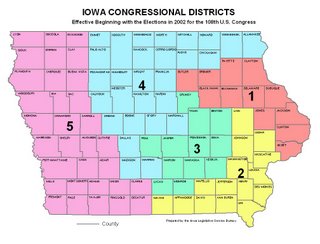

The Texas Legislature created their redistricting project. At least the Supreme Court shot down that wacky district you see in southwest Texas. This map represents why the Democrats held hostage the Texas Legislature a few years ago by escaping to Oklahoma. I can understand why no one really responded to their cries of "foul!" I imagine that the Democrats did their own gerrymandering when Ann Richards and her folks were leading Texas several years ago. Gerrymandering is not new, and it shouldn't be supported by the Supreme Court, of all places.
For all the Iowa jokes floating around Minnesota and South Dakota, I admire them for drawing sane (and democratic) district boundaries. Their accountability structures are sound, and the results were determined through an independent commission apart from party leadership. This structure of liberty and democracy is not enough to make me move to Iowa, but it is good to know that democracy is possible.
A congregation member whom I had pinned as a Republican (my mistake, my sin--I would hate to be put in a box as well) told me over lunch that he wasn't a Republican. He loves America, he just doesn't trust government. I'm not sure I agree with him about government trust, but I can understand the sentiment--I don't trust the two party system.
Elihu
Why?
Take the recent Supreme Court decision to uphold gerrymandering in Texas. Republicans and Democrats have done this for decades not for the sake of democratic ideals, but for the sake of maintaining their own power--and the Supreme Court just gave this kind of act a rubber stamp. Republicans and Democrats have meager accountability in the system we have. This is CRAP! If you have an excuse for why gerrymandering is a good thing, I would love to hear from you.
Let's compare the US Congress district maps of Texas and Iowa.


The Texas Legislature created their redistricting project. At least the Supreme Court shot down that wacky district you see in southwest Texas. This map represents why the Democrats held hostage the Texas Legislature a few years ago by escaping to Oklahoma. I can understand why no one really responded to their cries of "foul!" I imagine that the Democrats did their own gerrymandering when Ann Richards and her folks were leading Texas several years ago. Gerrymandering is not new, and it shouldn't be supported by the Supreme Court, of all places.
For all the Iowa jokes floating around Minnesota and South Dakota, I admire them for drawing sane (and democratic) district boundaries. Their accountability structures are sound, and the results were determined through an independent commission apart from party leadership. This structure of liberty and democracy is not enough to make me move to Iowa, but it is good to know that democracy is possible.
A congregation member whom I had pinned as a Republican (my mistake, my sin--I would hate to be put in a box as well) told me over lunch that he wasn't a Republican. He loves America, he just doesn't trust government. I'm not sure I agree with him about government trust, but I can understand the sentiment--I don't trust the two party system.
Elihu
Wednesday, June 28, 2006
Theories on a sense of place
I repeatedly listen to songs by Great Big Sea these days. Why?
Picturesque scenes in the Sioux Falls metro are not easy to take in. The namesake Falls represent a destination, not part of the daily commute. The Big Sioux River looks more like a muddy creek or an ice skating venue most of the time, although my family and I enjoy the water when we use the trails for a family hike or a bike ride.
In Douglas Coupland's book City of Glass--he writes about crossing the Lions Gate Bridge in Vancouver and how crossing it grounded him--the way he describes the bridge and its surroundings--I would go as far as to say he is filled with awe upon each crossing. The mountain views and seascape from the bridge represent a constant reminder of place and the importance of place in our lives. I would never say that people who live in the Sioux Falls metro have no sense of place, but from where do they attain their sense of place? The Falls indeed inspire reflection upon the magnitude of what God does through water and stone, but do people constantly think of the Falls in their daily living? Do people wax poetic about the Falls? I'm not so sure...
My next door neighbor grew up on a Hutterite Colony near Huron, South Dakota. He talks about how he loves living in Sioux Falls--but he didn't tell me about how great Sioux Falls is, rather how the Missouri River near Chamberlain inspires awe in him (in so many words--guys can talk about that kind of stuff over a beer). The Missouri River is a deep source of his grounding. I also know how easy it is to go for weeks at a time without leaving Sioux Falls. How does Sioux Falls metropolitan living maintain any connection with the land? For my wife, Augustana College inspires a strong sense of place--though not largely connected with South Dakota.
Our family carved a new ritual for land connection, at least during the summer. Our Saturday morning takes us to the Sioux Falls Farmers' Market--these days for lettuce, peppers, and new red potatoes. We walk by the river, take in the Falls, and contribute to the local produce trade while we take a look at other folk. We may even run into someone we know. Because of this new ritual, along the regular bike rides along the Big Sioux, I have finally developed a budding sense of place in Sioux Falls that is my own (gee, it only took me 5 years). As an interim pastor, I have served in other people's communities--I learned to appreciate the space in which they lived and worked, yet I never developed my own sense of place. Maybe this subject would never have entered my reflections had I always been serving in the place I lived...
The band Great Big Sea sings many of their songs about a life on the sea. Though I have never been much of a boater, my long term sense of place and connection with the land comes from my constant relationship with the water--much like in Coupland's reflections on the Lions Gate Bridge. One does not have to be a seafarer to maintain a relationship with the water. I cannot help water's grip on my soul (sounds like baptism, eh?) I am reminded of that soul grip in my musical rotation of Great Big Sea's "A Boat Like Gideon Brown." The song sings about the hopes of a father and son, the inspiration of the relationship between humanity and the sea, and the realm of possibility. I've listened to the song 15 times in the past three days. In that song I remember the seascapes of my youth, my sense of place, and the realm of possibility.

In the early days of my youth, our daily tasks took my family along the perimeter and across Lake Washington.

During my high school and breaks from university life, I frequently crossed and drove along the perimeter of the South Puget Sound.
The land and the realm of possibilities...
Elihu
Picturesque scenes in the Sioux Falls metro are not easy to take in. The namesake Falls represent a destination, not part of the daily commute. The Big Sioux River looks more like a muddy creek or an ice skating venue most of the time, although my family and I enjoy the water when we use the trails for a family hike or a bike ride.
In Douglas Coupland's book City of Glass--he writes about crossing the Lions Gate Bridge in Vancouver and how crossing it grounded him--the way he describes the bridge and its surroundings--I would go as far as to say he is filled with awe upon each crossing. The mountain views and seascape from the bridge represent a constant reminder of place and the importance of place in our lives. I would never say that people who live in the Sioux Falls metro have no sense of place, but from where do they attain their sense of place? The Falls indeed inspire reflection upon the magnitude of what God does through water and stone, but do people constantly think of the Falls in their daily living? Do people wax poetic about the Falls? I'm not so sure...
My next door neighbor grew up on a Hutterite Colony near Huron, South Dakota. He talks about how he loves living in Sioux Falls--but he didn't tell me about how great Sioux Falls is, rather how the Missouri River near Chamberlain inspires awe in him (in so many words--guys can talk about that kind of stuff over a beer). The Missouri River is a deep source of his grounding. I also know how easy it is to go for weeks at a time without leaving Sioux Falls. How does Sioux Falls metropolitan living maintain any connection with the land? For my wife, Augustana College inspires a strong sense of place--though not largely connected with South Dakota.
Our family carved a new ritual for land connection, at least during the summer. Our Saturday morning takes us to the Sioux Falls Farmers' Market--these days for lettuce, peppers, and new red potatoes. We walk by the river, take in the Falls, and contribute to the local produce trade while we take a look at other folk. We may even run into someone we know. Because of this new ritual, along the regular bike rides along the Big Sioux, I have finally developed a budding sense of place in Sioux Falls that is my own (gee, it only took me 5 years). As an interim pastor, I have served in other people's communities--I learned to appreciate the space in which they lived and worked, yet I never developed my own sense of place. Maybe this subject would never have entered my reflections had I always been serving in the place I lived...
The band Great Big Sea sings many of their songs about a life on the sea. Though I have never been much of a boater, my long term sense of place and connection with the land comes from my constant relationship with the water--much like in Coupland's reflections on the Lions Gate Bridge. One does not have to be a seafarer to maintain a relationship with the water. I cannot help water's grip on my soul (sounds like baptism, eh?) I am reminded of that soul grip in my musical rotation of Great Big Sea's "A Boat Like Gideon Brown." The song sings about the hopes of a father and son, the inspiration of the relationship between humanity and the sea, and the realm of possibility. I've listened to the song 15 times in the past three days. In that song I remember the seascapes of my youth, my sense of place, and the realm of possibility.

In the early days of my youth, our daily tasks took my family along the perimeter and across Lake Washington.

During my high school and breaks from university life, I frequently crossed and drove along the perimeter of the South Puget Sound.
The land and the realm of possibilities...
Elihu
Tuesday, June 27, 2006
Continuing in the love affair for the underdog: public higher education; collegiate baseball in the north; and beavers

Every beaver has their day. Some beavers may have more than one day.
In the realm of collegiate and professional athletics, college baseball attracts little attention. School is not even in session when the annual crowning event of collegiate baseball gathers in Omaha, Nebraska for the College World Series. As I do not have cable television that accomodates ESPN, I could not view the games. I did follow the results and stories--I feel a connection with the sport having spent two years of my life devoted to being a baseball "student-athlete." My youngest brother had a solid collegiate career playing at Portland State and the University of Nevada-Las Vegas. College baseball is a worthwhile event if you choose to watch sport.
I hoped that Oregon State Univeristy, (aka "The Beavers") would win the College World Series, because I pull for the Pac-10 in general, especially for the non-California schools. Also, a northern school had not won the College World Series since Ohio State in 1966. I have always found warmth and sunshine overrated, and I love to see that good baseball can be played in places where sun and warmth are not regular weather patterns. Go Beavers!
In researching OSU, I discovered that a Beaver alum attained an honored position of Presiding Bishop in the Episcopal Church, USA. Nevada Bishop Katharine Jefferts Schori earned two advanced degrees at Oregon State. Without knowing anything about Bishop Schori (although my Episcopalian friend Hawk speaks well of the new Bishop), I like this development for many reasons.
1. The Episcopal Church in the USA did not bow to the pressure of the Anglican Communion by backing away from its election of Gene Robinson, a gay man, as Bishop of New Hampshire.
2. With the election of Schori, the Episcopal Church also snubbed others in the Communion who do not believe in the ordination of women.
3. I love to hear about clergy who are given the opportunity to serve in the Church from backgrounds in public higher education. In my experience, people whose primary course of study involves theology in a Church college have superior backgrounds compared to us stiffs who attain their higher education from State U. We State U. folks may have less experience with theological lingo, but God has given us no less ability to engage in sound theology or to lead in the Church. I have not found explicit exclusion because of my educational background, however, the hierarchy seems implicit in favoring folk from Church college backgrounds--at least as I have seen in Lutheran circles. Schori holds advanced degrees in Oceanography. How cool is that for the Church? I would love to know if Bishop Schori has any interesting perspective on Leviathan from the Bible?
I enjoy the underdog story as much as the next person--though middle class folk may not truly live the life of an underdog, stories that reflect the diversity of God's people and creation give me hope that the Church can join what God is doing in the world. Even the beavers.
Elihu
Monday, June 26, 2006
Time to start a Canada club?
In taking a business meeting on the golf course, Rev. Darth took a look at my golf hat and inquired about the logo.
It's the CBC logo (little CBC logos sit to the right of some of the dates on the schedule below).

Rev. Darth shook his head. "Dude, you need to move to Canada."
I don't know if that will ever happen, but I can dream. If it would be a good move for the whole family, we'll do it. If not, we trust God will lead us to the right place. As much as I hate to admit it, Sioux Falls, South Dakota was the right place for us for this period of time. My wife has a good place to serve, I have learned from a breadth of congregations, we were able to afford a house...all good things. The time will come, sooner than later, when we will live out our callings in some other place. Canada is on the short list. If we do move there someday, this would not be our CFL home team, but "Sasketchewan Roughriders" does roll off the tongue.
Canadian subjects fills my recent reading list. Specificly, Douglas Coupland. I finished JPod last weekend. I loved it, though the reviews out there seem mixed. I like its commentary on technology and culture, neurological conditions, China, and life in Vancouver. Coupland seems married to Vancouver, in that he recognizes its gifts and warts. The depth of that love is supplemented by two previous non-fiction publications by Coupland: "Vancouver: City of Glass" and "Souvenir of Canada". After reading these 3 books in the past two weeks, I decided to fill out the collection. I bought 5 more Coupland books on half.com.
I don't think there's a Canada Club in Sioux Falls.

Elihu
It's the CBC logo (little CBC logos sit to the right of some of the dates on the schedule below).

Rev. Darth shook his head. "Dude, you need to move to Canada."
I don't know if that will ever happen, but I can dream. If it would be a good move for the whole family, we'll do it. If not, we trust God will lead us to the right place. As much as I hate to admit it, Sioux Falls, South Dakota was the right place for us for this period of time. My wife has a good place to serve, I have learned from a breadth of congregations, we were able to afford a house...all good things. The time will come, sooner than later, when we will live out our callings in some other place. Canada is on the short list. If we do move there someday, this would not be our CFL home team, but "Sasketchewan Roughriders" does roll off the tongue.
Canadian subjects fills my recent reading list. Specificly, Douglas Coupland. I finished JPod last weekend. I loved it, though the reviews out there seem mixed. I like its commentary on technology and culture, neurological conditions, China, and life in Vancouver. Coupland seems married to Vancouver, in that he recognizes its gifts and warts. The depth of that love is supplemented by two previous non-fiction publications by Coupland: "Vancouver: City of Glass" and "Souvenir of Canada". After reading these 3 books in the past two weeks, I decided to fill out the collection. I bought 5 more Coupland books on half.com.
I don't think there's a Canada Club in Sioux Falls.

Elihu
Wanna go suck tailpipes with me?
Where are my colleagues when I need to share some righteous indignation? In the summer people around the congregation scatter into their own Sabbath taking rhythms. I support that movement. However, I have some righteous indignation to share and the people with whom I usually engage in such a discussion are either on vacation or gone for the day.
Apparently, the United States Supreme Court will rule on a case that will dictate whether the Environmental Protection Agency and States can regulate carbon dioxide emissions from motor vehicles. The debate in principle sounds reasonable. Who gets to regulate and under what auspices seems like a reasonable discussion. Just because the premise is reasonable does not mean the arguments presented are reasonable.
Take this quote on the subject from an article from the Associated Press today:
"Fundamentally, we don't think carbon dioxide is a pollutant, and so we don't think these attempts are a good idea," said John Felmy, chief economist of the American Petroleum Institute, a trade group representing oil and gas producers.
Okay Johnny, please join me on 41st Street in Sioux Falls Saturday afternoon, and we can go on a bender where we suck on tailpipes of the idling cars on the busiest street in South Dakota.
Maybe this tailpipe treat isn't as big a deal in Sioux Falls as it would be in Manhattan (New York City, not Kansas), but PLEASE, tell us HOW carbon dioxide is not a pollutant. If carbon dioxide is not a pollutant, why do we need to exhale? If my science is bad, blame my teachers. Kidding, but John Felmy hardly seems like a reliable source, either.
The Associated Press went to a crappy source for a quote on this one.
Have a happy.
Elihu
Apparently, the United States Supreme Court will rule on a case that will dictate whether the Environmental Protection Agency and States can regulate carbon dioxide emissions from motor vehicles. The debate in principle sounds reasonable. Who gets to regulate and under what auspices seems like a reasonable discussion. Just because the premise is reasonable does not mean the arguments presented are reasonable.
Take this quote on the subject from an article from the Associated Press today:
"Fundamentally, we don't think carbon dioxide is a pollutant, and so we don't think these attempts are a good idea," said John Felmy, chief economist of the American Petroleum Institute, a trade group representing oil and gas producers.
Okay Johnny, please join me on 41st Street in Sioux Falls Saturday afternoon, and we can go on a bender where we suck on tailpipes of the idling cars on the busiest street in South Dakota.
Maybe this tailpipe treat isn't as big a deal in Sioux Falls as it would be in Manhattan (New York City, not Kansas), but PLEASE, tell us HOW carbon dioxide is not a pollutant. If carbon dioxide is not a pollutant, why do we need to exhale? If my science is bad, blame my teachers. Kidding, but John Felmy hardly seems like a reliable source, either.
The Associated Press went to a crappy source for a quote on this one.
Have a happy.
Elihu
Subscribe to:
Posts (Atom)

